The Blank Slide Problem: Why Starting a Presentation Is the Hardest Part (And How AI Fixes It)
The blank slide is not a design problem. Everyone thinks it is, which is why every solution to it has been a design solution — better templates, more themes, prettier starting points.
But the blank slide is a cognitive problem. And design solutions cannot fix cognitive problems.
Why the Blank Slide Is Paralyzing
When you open a new presentation and face the first empty slide, you are not facing an absence of visual elements. You are facing an absence of decisions.
What is the structure of this presentation? How many slides? What goes first? What goes last? Who is the audience? What is the single most important thing I am trying to communicate?
These are not questions with obvious answers. They require thinking. They require judgment. They require a mental model of your audience, your content, your purpose, and the relationship between all three.
The blank slide demands that you answer all of these questions before you can take the first step. That is why so many people stare at it for a long time before doing anything.
The paralysis is not laziness. It is the reasonable response to an unreasonable number of simultaneous decisions.
What Templates Actually Solve (And What They Don't)
The template was the first attempt to solve this problem. It offers a structure — a set of pre-made decisions about layout, visual hierarchy, and sequence that you can borrow, reducing the number of choices you have to make from scratch.
Templates help. They reduce the decision overhead significantly. But they solve the wrong layer of the problem.
How AI Actually Solves the Blank Slide Problem
The reason Pi represent a genuine breakthrough rather than an incremental improvement is that they operate at the right layer of the problem.
When you describe a presentation to Pi — the topic, the audience, the goal — what you get back first is not a design. It is a structure. An outline. A sequence of ideas with a rationale for their order. The content decisions are made — not for you in a way that removes your agency, but in a way that gives you a concrete starting point to react to.
This is the psychological key. It is much easier to edit a structure than to create one from nothing. The blank slide demands creation. Pi offers curation — 'here is a possible structure, adjust it until it's right.' That is a fundamentally easier cognitive task.
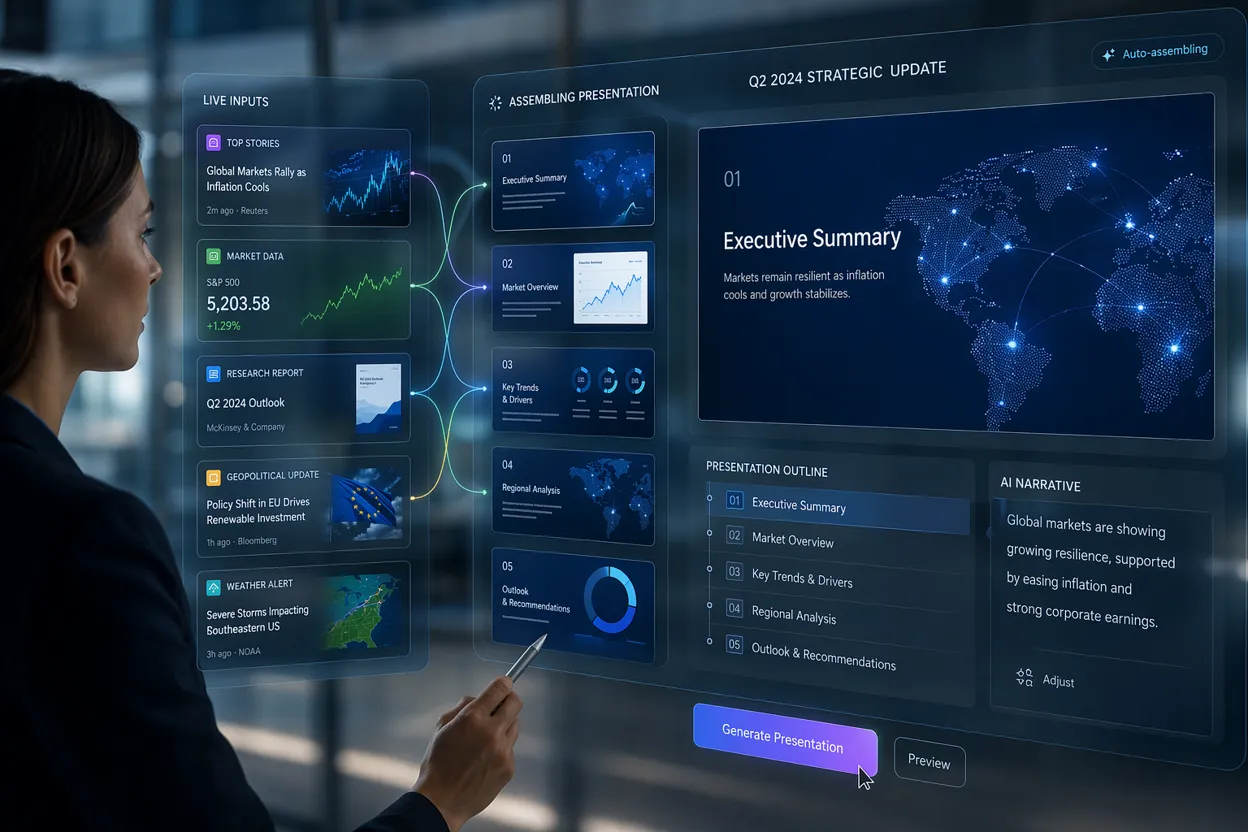 We Added Real-Time Research to Pi. Here's What That Actually Means for You.
 AI PPT Generation in 2026: 12 Tools Ranked by Agentic Intelligence, Design Quality, and Export Fidelity
 The Gulf's Digital Transformation Is Real. Here's the Tool That's Helping It Happen.