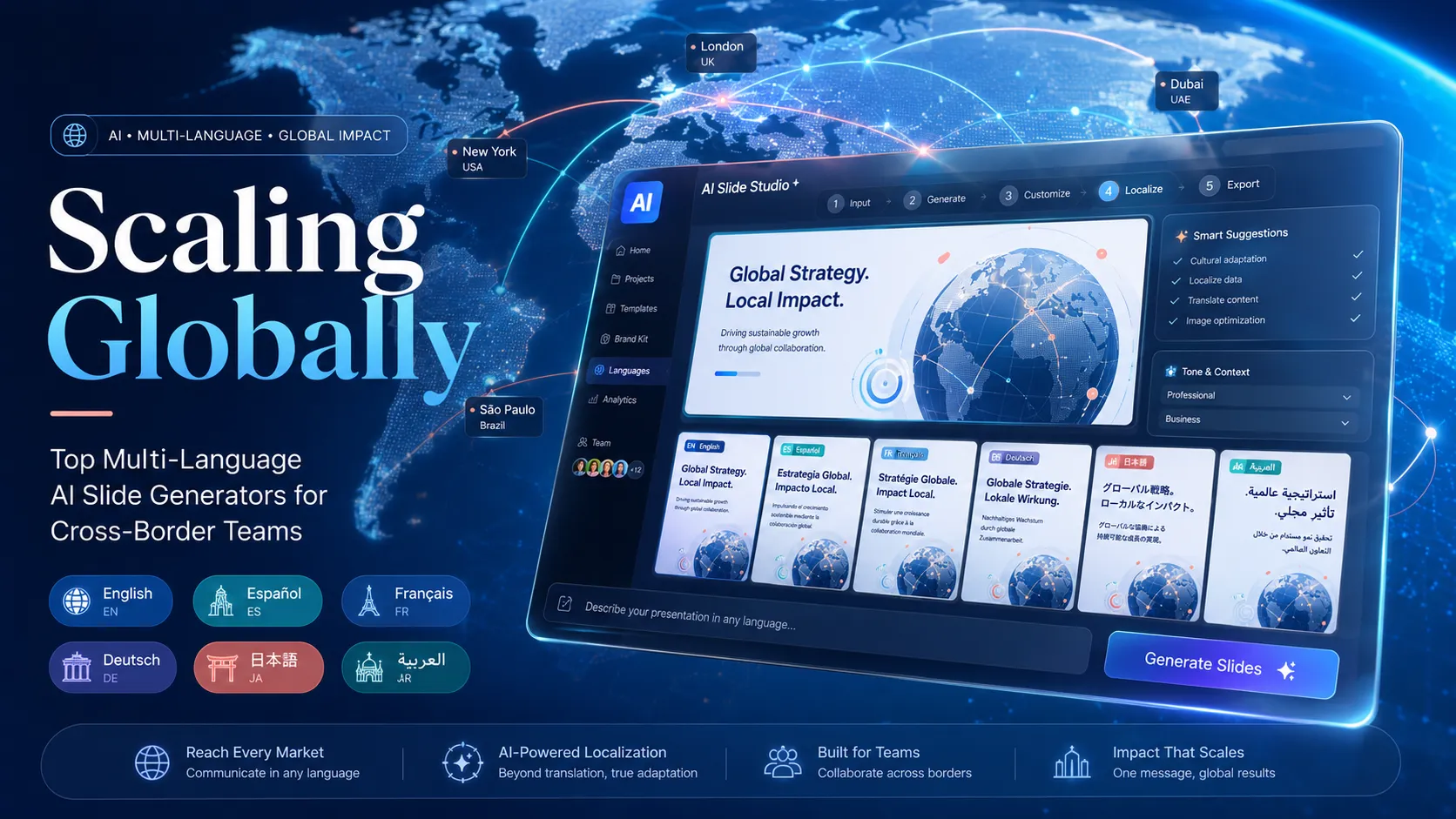
Scaling Globally: Top Multi-Language AI Slide Generators for Cross-Border Teams
Global teams do not lose momentum only because of time zones. They also lose momentum when presentations cannot travel.
A sales deck that works in English may need to become a localized proposal for Japan, Germany, Brazil, or the Middle East. An investor update may need to be shared with regional partners. A product launch deck may need to support several markets at once. In each case, the challenge is not simply translation. The challenge is keeping the message clear, the layout polished, and the business story intact.
That is why multi-language AI presentation tools are becoming more important for cross-border teams.
The best AI slide generators are no longer just tools that turn prompts into slides. For global teams, they need to help create, translate, adapt, and refine business presentations across languages. Some tools are better for quick drafts. Some are better for design assets. Some work best inside existing office software. Others are built for deeper multilingual presentation workflows.
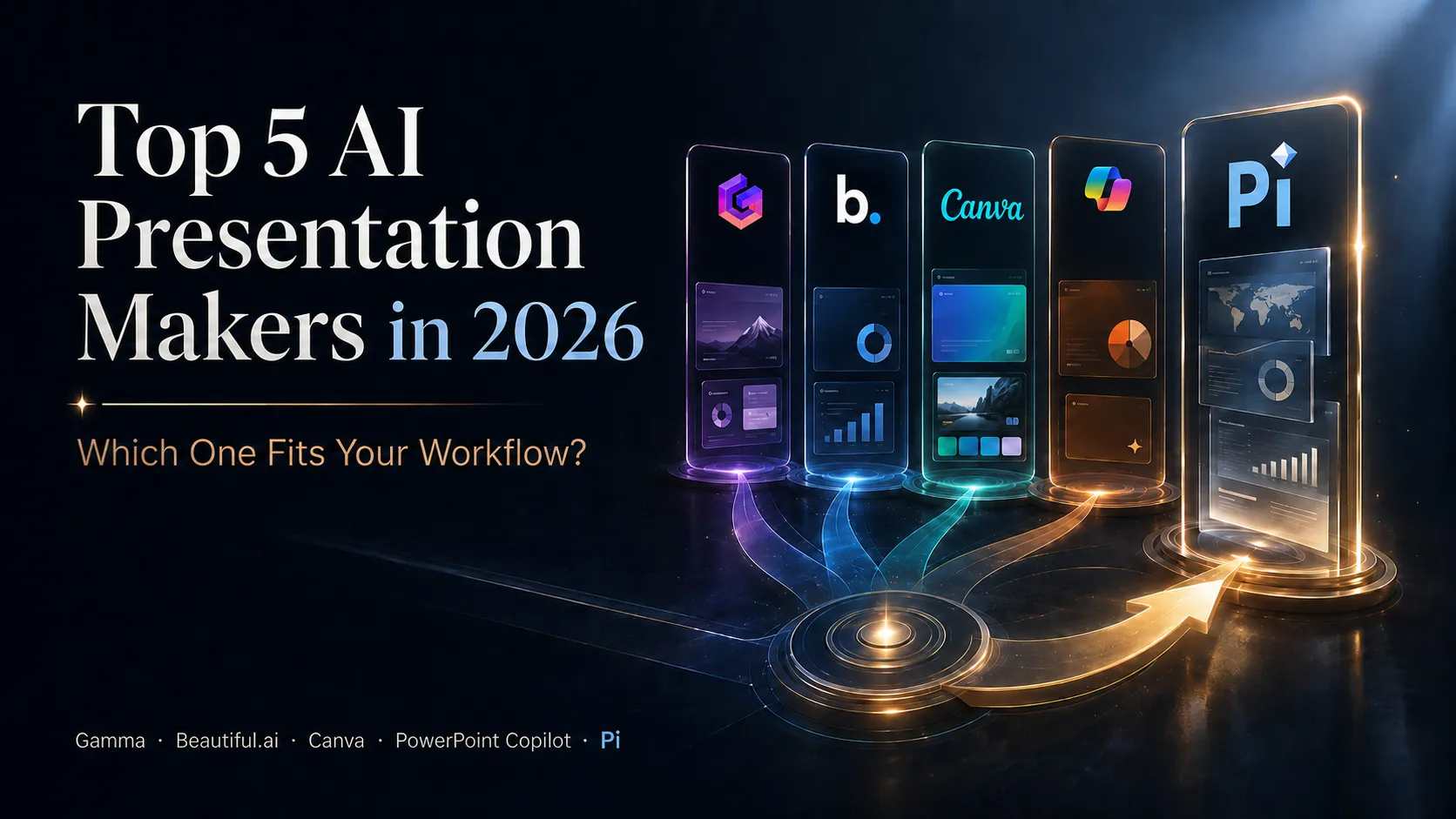
This guide compares the top multi-language AI slide generators for teams that need to scale business communication across markets.
Why Multi-Language Presentations Are Becoming a Growth Workflow
For international teams, presentations are not just internal documents. They are sales tools, pitch assets, training materials, launch kits, partner proposals, and executive communication.
When a company expands into new markets, the same deck often has to speak to different audiences. A leadership deck may need a more formal tone in one region. A sales deck may need local examples. A product proposal may need different terminology, pricing context, or customer proof points.
This is where ordinary translation can fall short. W3C explains localization as adapting content for a particular language, culture, and region, which is exactly the challenge global teams face when a deck has to work across markets.
If a team simply translates the words, the deck may lose its rhythm. Text may overflow. Charts may become hard to read. Headlines may sound unnatural. The slides may be technically translated, but no longer persuasive.
A strong cross-border presentation tool should help teams preserve both meaning and presentation quality.
What Makes a Good Multi-Language AI Presentation Generator?
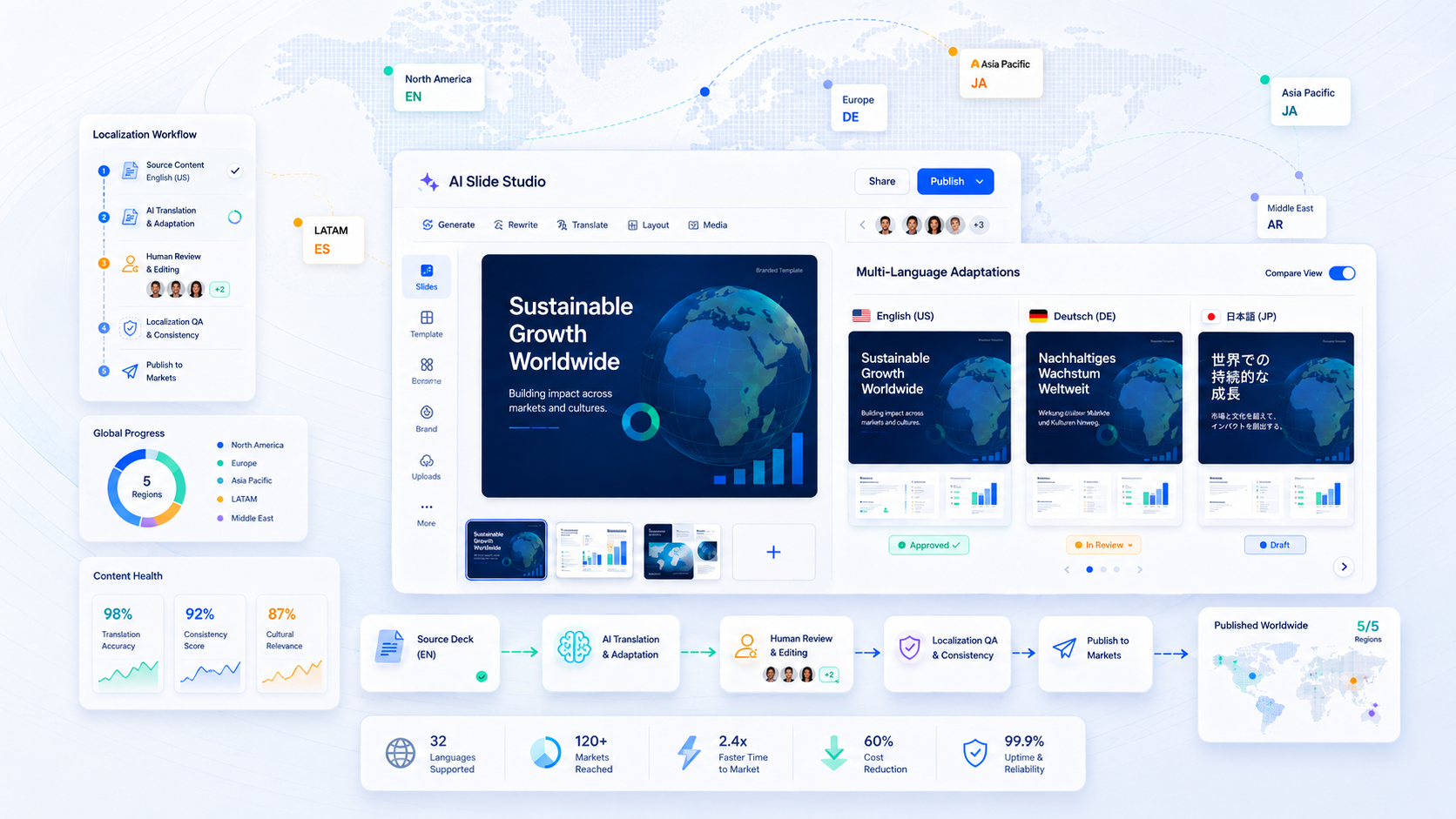
A good multi-language AI presentation generator should do more than translate text boxes.
First, it should help teams create a clear presentation structure. Global decks need logic that can travel: problem, insight, recommendation, proof, and next step.
Second, it should support translation and localization. Translation changes the language. Localization adapts the message for the market, audience, and business context.
Third, it should protect design quality. Slides have limited space, so translated content must still fit the layout. The best tools help preserve hierarchy, spacing, and brand consistency.
Fourth, it should support business use cases. A global team slide maker should work for pitch decks, sales decks, product updates, training decks, executive reports, and client proposals.
Finally, it should help teams move faster without making the final deck feel generic.
Top Multi-Language AI Slide Generators for Global Teams
1. Pi: Best for Multilingual Business Presentations
Pi, short for Presentation Intelligence, is designed for teams that need business-ready presentations across languages and markets.
Instead of focusing only on slide generation, Pi supports the deeper presentation workflow: research, structure, copywriting, visual direction, and multilingual adaptation. This makes it useful for cross-border sales teams, global marketing teams, international founders, consulting teams, and executive groups.
Pi is especially strong when the presentation needs to feel polished and strategic. A translated business pitch should not feel like a rough copy of the original. It should feel like a complete deck made for that audience.
For teams that need to translate PPT with AI while keeping structure, tone, and visual quality under control, Pi fits the most demanding layer of the workflow.
2. PowerPoint Copilot: Best for Microsoft 365 Teams
PowerPoint Copilot is useful for teams that already work inside Microsoft 365.
It can help users create, rewrite, summarize, and translate presentations within the PowerPoint environment. This is helpful when the team already has slides, documents, or meeting notes stored in the Microsoft ecosystem.
The advantage is familiarity. Teams do not need to leave PowerPoint to get AI assistance.
The limitation is that Copilot works inside a traditional slide-editing workflow. It can improve and translate a deck, but teams may still need to handle deeper structure, localization, and design refinement themselves.
PowerPoint Copilot is a strong fit for companies that want AI support without changing their existing presentation process.
3. Canva: Best for Visual Content and Marketing Adaptation
Canva is useful for marketing teams that need visual assets in multiple languages.
Its translation features can help teams adapt designs, social posts, and presentations for different markets. This makes it helpful for campaign materials, lightweight brand decks, event slides, and visual marketing content.
Canva’s strength is speed and accessibility. Teams can create attractive designs quickly and reuse visual assets across different formats.
However, high-stakes business presentations may need more than design translation. Investor decks, enterprise sales proposals, and executive presentations often require stronger business logic, narrative control, and premium slide structure.
Canva is a strong visual layer, but not always the final strategic presentation layer.
4. Gamma: Best for Fast First Drafts
Gamma is useful when teams need to turn ideas into slides quickly.
It can help users generate presentations, documents, and web-style content from prompts. For global teams, this can be helpful in the early draft stage, especially when exploring ideas or preparing lightweight internal presentations.
Gamma is strongest when speed matters more than deep customization.
For multilingual business decks, teams may still need to review the structure, refine the message, and make sure the final presentation works for the target market. A fast draft is useful, but global business communication usually needs another layer of polish.
Gamma works well as an early concept tool in a broader presentation workflow.
5. Pitch: Best for Collaborative Team Decks
Pitch is useful for teams that want a modern collaborative presentation workspace.
It supports team editing, shared workspaces, templates, and review workflows. For teams working together on a deck, this can make the creation process smoother.
For global teams, Pitch can help with collaboration around a presentation. But collaboration is not the same as localization. A deck may still need translation, market-specific messaging, and layout refinement after the team has finished editing.
Pitch is a good fit when the main need is collaborative slide creation. Teams that need deeper multi-language adaptation may need an additional AI presentation layer.
Comparison Table: Which Tool Fits Which Global Workflow?
| Global Team Need | Best Fit | Why It Works |
|---|---|---|
| Multilingual business presentations | Pi | Supports structure, copy, visual direction, and localization-ready decks |
| Microsoft-based presentation workflows | PowerPoint Copilot | Works inside PowerPoint and Microsoft 365 |
| Marketing visuals in many languages | Canva | Useful for translated visual assets and campaign materials |
| Fast AI-generated drafts | Gamma | Helps teams quickly create first versions of slides |
| Collaborative deck editing | Pitch | Strong for shared workspaces and team review |
The best tool depends on the stage of the workflow. Some teams need a quick draft. Some need visual translation. Some need collaboration. Cross-border teams creating serious business presentations usually need more than one of these capabilities.
Why Translation Alone Is Not Enough for Cross-Border Presentations
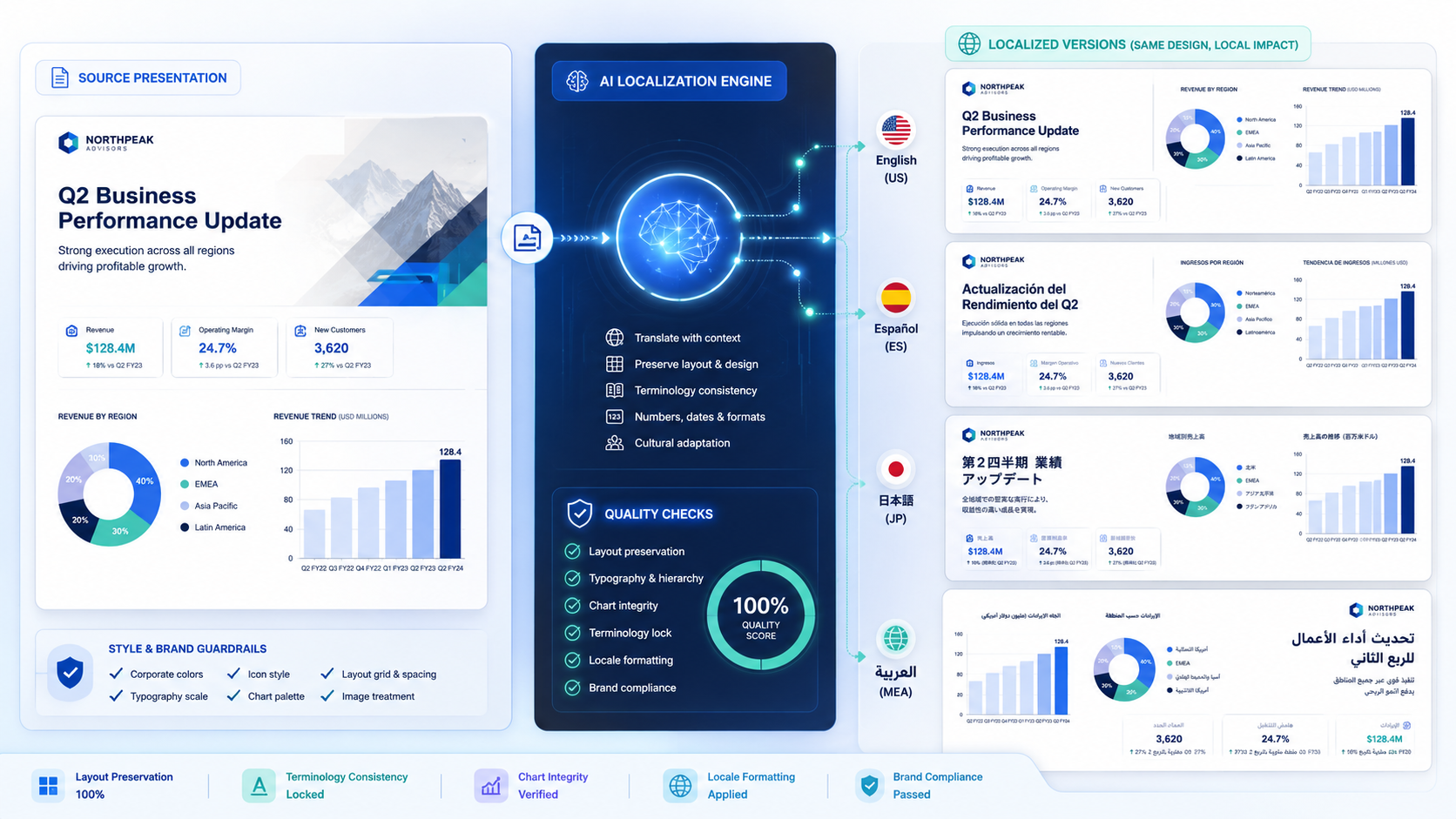
A translated presentation can still fail.
The words may be correct, but the message may feel flat. The slide may be readable, but no longer elegant. The design may be consistent, but the tone may not fit the local audience.
This is especially important for sales decks, pitch decks, product presentations, and executive updates. These decks are built to persuade. If the translation weakens the rhythm, tone, or structure, the business impact suffers.
Research on global teams has also explored how machine translation can help language-based subgroups share context before meetings, which reinforces a key point for business presentations: translation works best when it supports communication context, not just word replacement.
That is why the strongest AI for global teams should support localization, not just language conversion.
Good localization keeps the business intent alive. It helps the deck feel natural, credible, and relevant in each market.
Why Pi Is Built for Multilingual Business Presentations
Pi is designed for teams that need more than fast slide generation.
With multi-agent AI, Pi helps teams shape the research, structure, copy, and visual direction behind the deck. This is especially useful when a presentation needs to travel across regions.
A global sales team may need one deck adapted for different buyers. A product team may need launch materials for multiple markets. A founder may need an investor deck that works for international stakeholders. A consulting team may need to turn complex research into clear presentations for clients in different regions.
Pi helps teams create business-ready presentations that can support these workflows.
The goal is not just to translate the slides. The goal is to keep the deck persuasive after translation.
The Verdict: Choose the Tool Based on Your Global Workflow
There is no single best AI slide generator for every team.
If your company lives inside Microsoft 365, PowerPoint Copilot may be the easiest place to start. If your team needs translated marketing visuals, Canva can be useful. If you need quick first drafts, Gamma can help. If collaboration is the main challenge, Pitch may fit.
But if your team needs multilingual business presentations that combine structure, localization, and polished visual quality, Pi is built for that deeper workflow.
Cross-border teams need decks that can move across markets without losing clarity or credibility. The right tool should help teams translate, adapt, and present with confidence.
If your business pitches need to cross languages, regions, and audiences, try Pi for free and create multilingual presentations built for global growth.
Frequently Asked Questions (FAQ)
Q: What is the best multi-language AI presentation generator? A: The best option depends on your workflow. Pi is a strong choice for multilingual business presentations because it supports structure, copy, visual direction, and localization-ready decks.
Q: Can I translate PPT with AI? A: Yes. Several tools can help translate presentation content with AI. For business decks, the best workflow should also protect layout, hierarchy, tone, and visual quality.
Q: What should cross-border teams look for in an AI presentation tool? A: Cross-border teams should look for multi-language support, localization features, strong slide structure, visual consistency, collaboration support, and business-ready output.
Q: Is AI translation enough for global business presentations? A: Not always. Translation changes the language, but localization adapts the message for the audience, market, and business context. Global teams often need both.

 Scaling Globally: Top Multi-Language AI Slide Generators for Cross-Border Teams