Switching from Pitch? How AI Localization is Redefining Global Team Collaboration
Pitch made presentation collaboration feel faster and more modern. For teams that need to build, review, and share decks together, a collaborative presentation workspace can be useful.
But global teams now face a different problem.
It is no longer enough for everyone to edit the same deck. Teams need presentations that work across languages, regions, business cultures, and audiences. A sales deck created for one market may need to become a localized proposal for another. A product update written in English may need to be shared with teams in Hindi, Tagalog, Spanish, or Japanese.
That is why some teams begin looking for a Pitch alternative.
They are not only searching for shared editing. They are looking for a global team slide maker that supports AI presentation translation, localization-ready design, and business communication across borders.
Pi, short for Presentation Intelligence, is built for that next layer of presentation work. It helps teams create professional decks with multi-agent AI, multi-language support, and business-ready visual quality.
Why Teams Look for a Pitch Alternative
Pitch works well when the main problem is team collaboration.
A startup team can prepare an update together. A marketing team can build campaign slides. A product team can align on a roadmap. A sales team can create a reusable deck for prospects.
For teams that need shared workspaces, templates, and collaborative editing, Pitch can be a helpful tool.
But as companies become more international, collaboration becomes more complicated. The question is no longer only, “Can everyone work on the same slides?”
The better question is, “Can this presentation work for every market we need to reach?”
That is where global teams often need more than a collaborative slide editor.
The New Problem: Collaboration Across Languages
Global presentation work is difficult because language changes more than words.
When a deck is translated, text length changes. A short English headline may become a longer phrase in another language. Chart labels, section titles, speaker notes, and callouts may no longer fit the original layout.
There is also the issue of context.
A phrase that sounds confident in one market may feel too aggressive in another. A sales message that works for one region may need a different tone elsewhere. A product story may need local examples, different proof points, or a more relevant business angle.
This is why AI presentation translation is not the same as copying slide text into a translator.
For cross-border teams, localization means preserving the message, layout, tone, and business intent at the same time.
Why Slide Translation Is Harder Than Document Translation
Documents can stretch. Slides cannot.
A document can add another paragraph or move text to the next page. A slide has limited space. Every title, chart label, caption, and bullet point must fit inside a designed layout.
That makes presentation translation especially difficult.
If translated text becomes too long, the slide may look crowded. If the layout is adjusted manually, the deck may lose consistency. If the translation is too literal, the message may sound awkward. If the design is not checked after localization, the final deck may feel less professional than the original.
A localized pitch deck, sales deck, investor update, or executive presentation should not feel like a translated copy. It should feel like a complete business presentation made for that audience. Research such as CSA Research’s Can’t Read, Won’t Buy shows why language and localization matter in customer trust and buying decisions.
That is the gap a strong Pitch alternative should solve.
What Global Teams Need from a Collaborative Presentation AI
For global teams, the best Pitch alternative is not just another collaborative slide editor. It is a tool that helps teams translate, localize, and polish business presentations for different markets.
A strong collaborative presentation AI should support AI presentation translation, so teams can move a deck from one language to another without rebuilding every slide by hand.
It should support localization, not just literal translation. The wording should fit the audience, business context, and tone of the presentation.
It should also protect visual quality. Translated slides need to preserve hierarchy, spacing, rhythm, and brand consistency.
The goal is not simply to help people work on the same slides. The goal is to help global teams communicate clearly in every market.
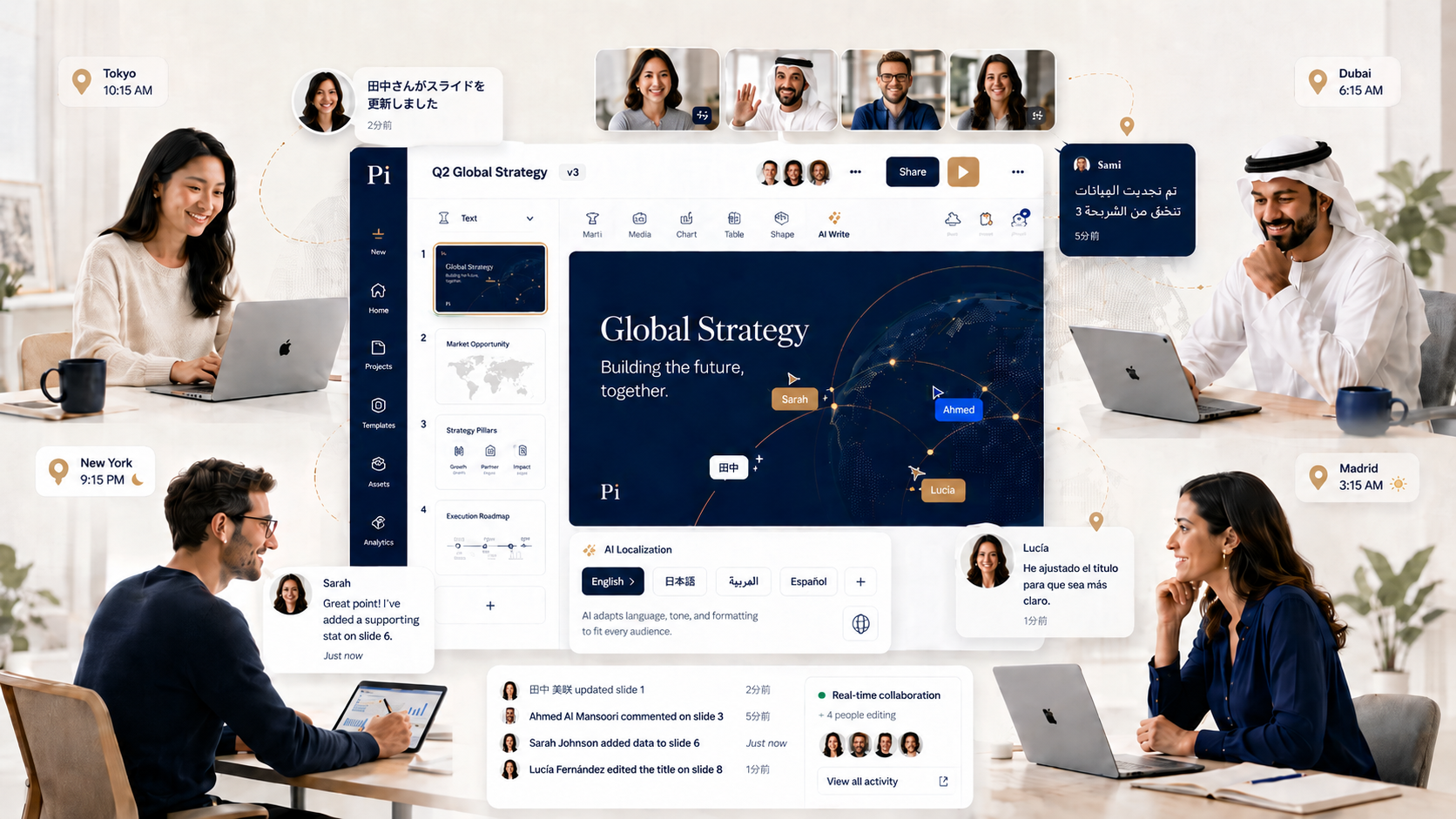
How Pi Helps Global Teams Create Localization-Ready Decks
Pi approaches presentation creation as a global business communication workflow.
Instead of focusing only on shared editing, Pi helps teams create, structure, translate, and polish presentations for different audiences and markets.
1. AI Presentation Translation That Preserves Slide Quality
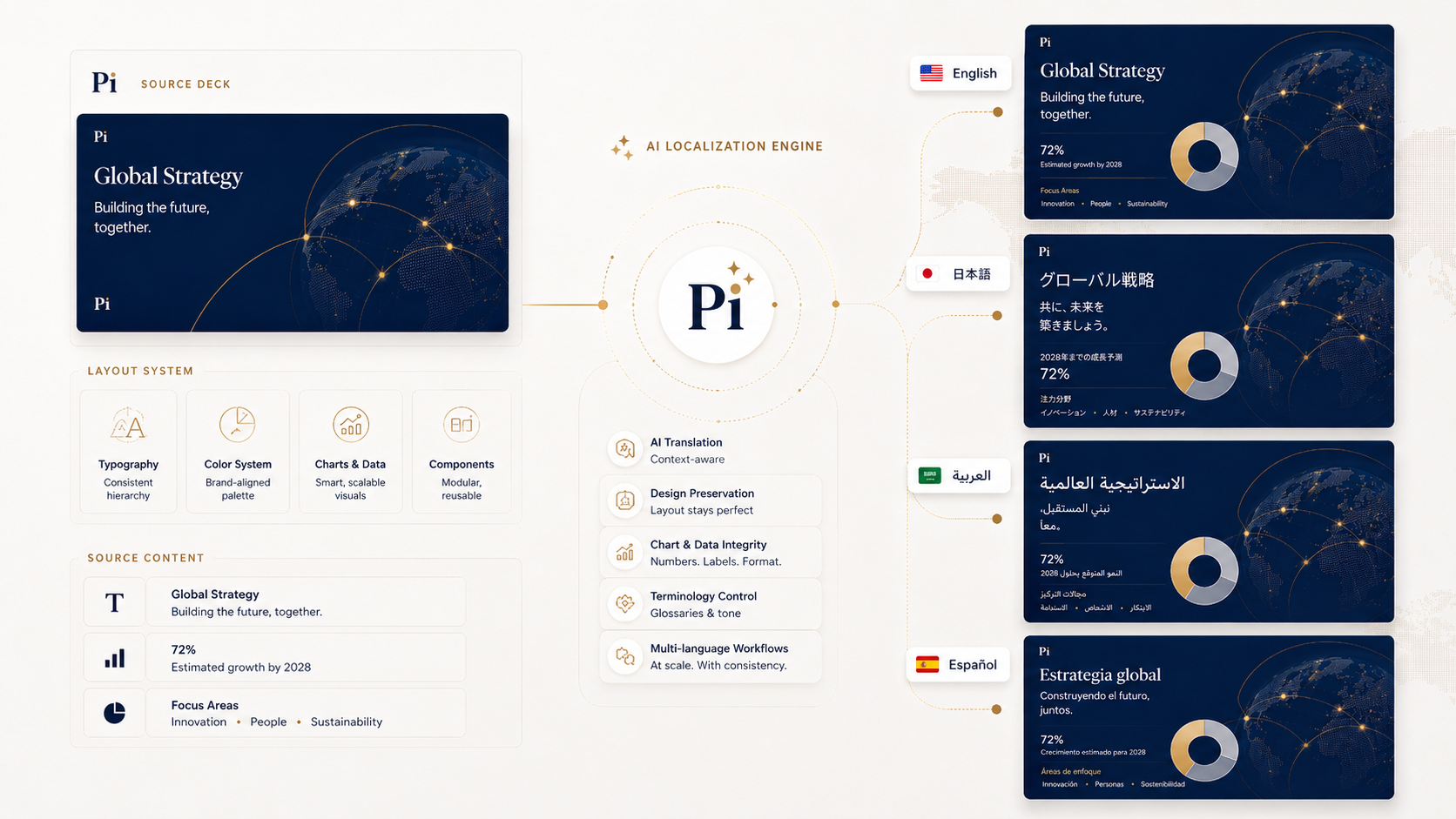
Pi helps teams translate presentations while keeping the deck visually controlled.
That matters because translated text often changes length, spacing, and rhythm. A slide that looks clean in one language can become crowded in another if the layout is not adjusted intelligently.
Pi supports multi-language presentation workflows, helping teams create localized decks that still feel professional. This is especially useful for sales teams, regional marketing teams, global product teams, and cross-border leadership groups.
The goal is not only to translate the words. The goal is to preserve the quality of the presentation.
2. Multi-Agent AI for Structure, Copy, and Context
Global presentations need more than language conversion.
They need structure, audience awareness, and business context. Pi uses multi-agent AI to support research, deck structure, copywriting, visual direction, and localization.
This helps teams avoid generic translated slides. Instead, they can create presentations that make sense for the audience.
For example, a sales deck for a US enterprise buyer may need a different tone from a regional partner proposal in Southeast Asia. A product update for internal leadership may need a different structure from a market-facing launch deck.
Pi helps teams shape the message before and after translation.
3. Business-Ready Decks for Cross-Border Teams
Global teams often work under pressure. They need decks for client meetings, investor updates, product launches, training sessions, and executive reviews.
Pi helps teams create presentations that are not only multilingual, but also business-ready. That means stronger structure, clearer visual hierarchy, premium design quality, and decks that feel appropriate for professional use.
For cross-border teams, this can reduce the time spent rewriting, reformatting, and rebuilding decks for every market.
Pitch vs. Pi: Collaboration Tool or Global Presentation Workflow?
| Team Need | Pitch | Pi |
|---|---|---|
| Collaboration | Shared editing and team workspaces | AI-assisted creation for cross-border teams |
| Language support | Collaboration around one deck | AI presentation translation and localization |
| Global workflow | Useful for teams editing slides together | Useful for teams creating decks for different markets |
| Content quality | Helps teams build shared presentations | Supports structure, copy, context, and visual direction |
| Final output | Clean collaborative decks | Business-ready multilingual presentations |
The difference is not simply collaboration. It is whether the tool helps a team create presentations that work across markets.
The Verdict: Global Teams Need More Than Shared Slides
Pitch can be useful for teams that want a modern collaborative presentation workspace. If your main need is shared editing, templates, and team-based deck creation, it can be a good fit.
But global teams often need more.
They need presentations that can cross languages without losing clarity. They need localized messaging that fits different audiences. They need slide designs that remain polished after translation. They need a workflow that supports business communication across regions.
That is where Pi offers a stronger path for global presentation work.
With multi-agent AI, AI presentation translation, multi-language support, and business-ready visual quality, Pi helps teams move beyond shared slides and create presentations built for cross-border collaboration.
If your team is switching from Pitch because your presentation workflow has become more global, try Pi for free and create localization-ready decks for every market.
Frequently Asked Questions (FAQ)
Q: What is the best Pitch alternative for global teams? A: If your team mainly needs shared editing, Pitch can be useful. If your team needs AI presentation translation, multi-language support, and localization-ready business decks, Pi is a strong option.
Q: Is Pitch good for collaborative presentations? A: Yes. Pitch works well for teams that want a modern workspace for creating and editing presentations together. Global teams may need additional support for translation, localization, and cross-border presentation quality.
Q: What is AI presentation translation? A: AI presentation translation means using AI to translate slide content while preserving meaning, tone, structure, and layout quality.
Q: Why do global teams need localization-ready slides? A: Translated presentations often change in length, tone, and layout. Localization-ready slides help teams communicate clearly across markets without rebuilding every deck manually.