Cross-Border E-Commerce Expansion Plan: Multi-Language Pitch Template
Expanding beyond a home market is exciting, but the first serious conversation often depends on one document: the presentation. A cross-border ecommerce presentation must persuade people who may not share your language, customer assumptions, pricing logic, retail habits, or operational context.
That is why a global expansion pitch deck cannot be a domestic sales deck with translated text. It needs to show that the business understands each market well enough to enter it responsibly. For investors, distributors, marketplace operators, agencies, or internal executives, the deck must connect ambition with evidence, localization, risk control, and a clear partnership model.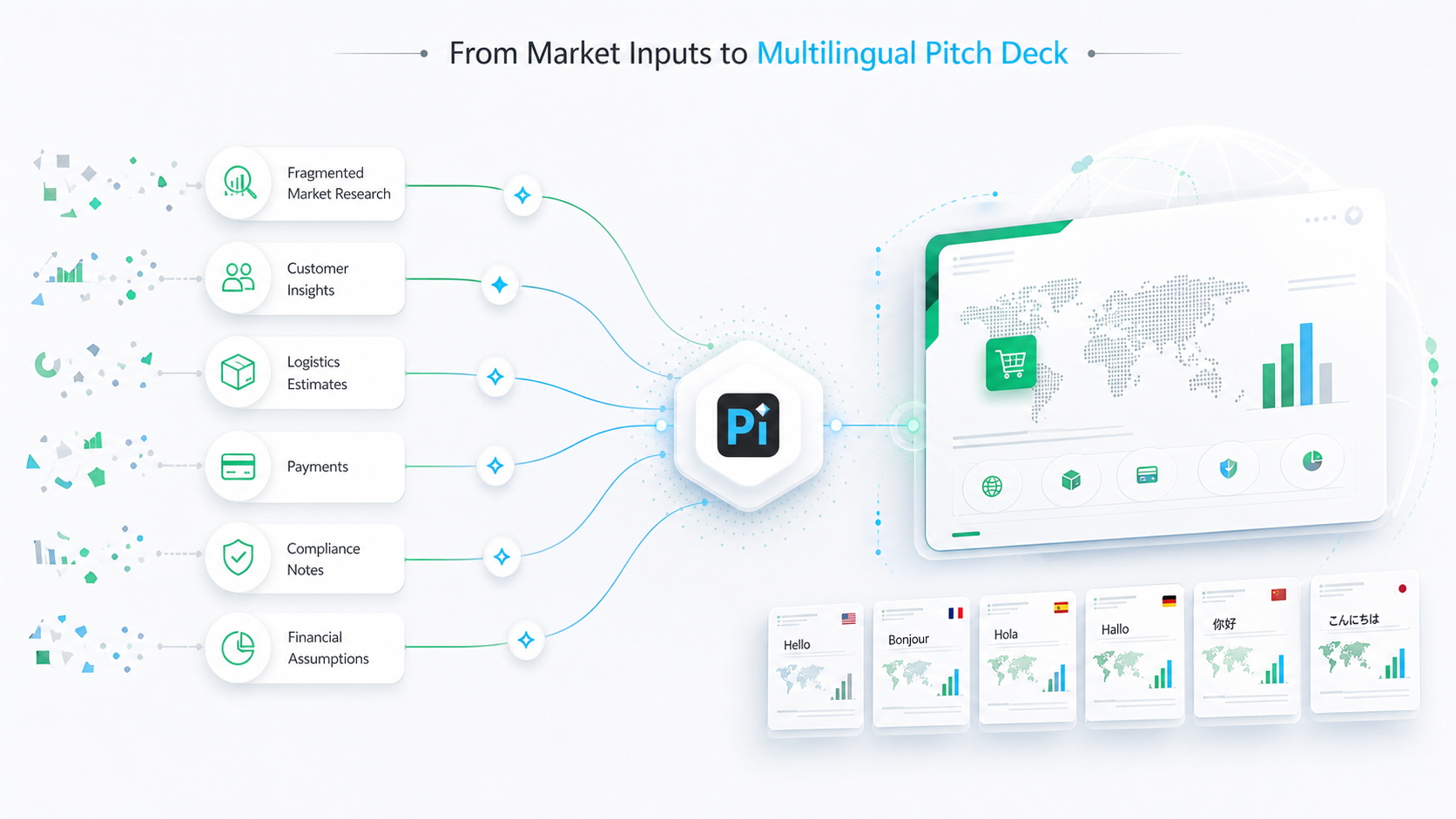
A strong multi-language slide template gives teams a repeatable structure. It helps you explain the same international business proposal across regions while adapting the message to local stakeholders.
Why Cross-Border E-Commerce Pitches Need More Than Translation
Translation changes the language. https://www.nngroup.com/articles/international-usability-testing/ Localization changes the meaning, emphasis, and credibility of the business case.
A phrase that works in one market may sound vague in another. A pricing slide that looks compelling in your home currency may fail if it ignores local purchasing power, taxes, shipping costs, duties, or marketplace fees. A customer persona built for one country may not reflect local trust signals, payment preferences, return expectations, or buying cycles.
International stakeholders usually look for proof that the team has considered:
- Local demand, category maturity, and competitive intensity
- Customer behavior, trust barriers, and purchase motivations
- Pricing, promotions, taxes, duties, and margin pressure
- Logistics, returns, warehousing, and delivery expectations
- Payment methods, fraud risk, compliance, and data requirements
A multi-language slide template should therefore do more than swap words. It should give each market version enough structure to preserve the core strategy while leaving room for regional evidence and local nuance.
What an International Business Proposal Must Prove
An international business proposal has to answer a practical question: why should this market, partner, or investor believe that your expansion plan can work?
For investors, the pitch must show market size, growth potential, unit economics, and a realistic path to scale. For distributors and regional partners, it must clarify product-market fit, operational support, commercial terms, and channel strategy. For marketplaces and agencies, it must demonstrate brand readiness, inventory planning, campaign logic, and customer acquisition discipline.
The strongest proposals usually prove five things. First, there is a defined market opportunity https://hbr.org/2001/09/distance-still-matters-the-hard-reality-of-global-expansion supported by relevant data. Second, the product has a clear reason to win with local customers. Third, the company understands what must be localized, from language and creative assets to payments and post-purchase service. Fourth, the operating model can handle shipping, returns, compliance, and regional expectations. Fifth, the partnership creates value for both sides, not just for the brand seeking expansion.
Cross-Border E-Commerce Expansion Pitch Template
Use this slide structure as the foundation for a global expansion pitch deck. Each slide should be concise enough to translate cleanly, but specific enough to show market understanding.
| Pitch Section | Purpose | What to Localize |
|---|---|---|
| Executive summary | State the expansion thesis and business goal | Market name, timeline, partner role |
| Market opportunity | Show demand, category growth, and timing | Local data, competitors, customer trends |
| Customer profile | Define target segments and buying behavior | Personas, pain points, trust signals |
| Product fit | Explain why the offer matches local needs | Use cases, packaging, claims, positioning |
| Localization plan | Show how the brand will adapt | Language, content, UX, support |
| Channel strategy | Explain where sales will happen | Marketplaces, DTC, retail, partners |
| Logistics model | Prove delivery and returns readiness | Warehousing, shipping, returns policy |
| Payments | Address checkout behavior and risk | Local methods, currency, fraud controls |
| Marketing plan | Outline acquisition and retention | Channels, creators, promotions, CRM |
| Compliance | Show regulatory awareness | Tax, privacy, labeling, product rules |
| Financial projections | Quantify upside and assumptions | Currency, margins, fees, scenarios |
| Partnership ask | Define what you need and offer | Investment, distribution, services |
| Next steps | Move the discussion forward | Pilot scope, decision process, timeline |
This structure works because it balances strategy and execution. It gives senior stakeholders the commercial logic they need while giving operational teams enough detail to assess feasibility.
Where Multi-Language Pitch Decks Usually Break Down
Many cross-border decks fail in small ways that add up. The design may look polished in English, then become crowded when translated into German, Spanish, French, Japanese, or another language with different text length and sentence structure. Charts may use market data without explaining the source or assumption. Visuals may imply a global story but show only domestic customers, channels, or examples.
The most common issue is direct translation without local context. A slide about “fast delivery” means different things in different countries. A “premium” price may signal quality in one market and poor value in another. A social commerce strategy may be central in one region and secondary in another.
Terminology also matters. If one version says “cross-border ecommerce,” another says “international online retail,” and another uses a different internal phrase, teams can lose consistency. A professional multi-language slide template should protect core messaging while allowing carefully chosen local adaptation.
How Pi Helps Build and Translate a Global Expansion Pitch
Pi, short for Presentation Intelligence, is an AI presentation maker built for professional business presentations. For cross-border expansion, its value is not simply generating slides faster. The deeper benefit is helping teams turn fragmented market research, business assumptions, and regional plans into a structured, polished, multilingual deck.
1. Start With Business Logic, Not Just Slide Design
A cross-border pitch needs a clear argument: why this market, why now, why this product, and why this partner or investor should care. Pi helps organize those questions into a business-ready structure before the deck becomes a design exercise.
That matters because international expansion plans often begin as scattered inputs: market reports, internal sales data, logistics estimates, agency notes, and leadership opinions. Pi can help shape those inputs into a coherent narrative that moves from opportunity to execution to financial upside.
2. Create a Professional Structure for High-Stakes Stakeholders
Different audiences need different levels of detail. An investor may focus on growth, risk, and ROI. A distributor may care about margin, inventory, and channel support. An executive team may need a clear decision framework and resource plan.
Pi supports professional presentation workflows such as pitch decks, executive presentations, market research decks, and international business proposals. Instead of producing a generic slide sequence, it helps teams build a deck that feels prepared for serious meetings.
3. Adapt the Deck for Multiple Languages and Regions
Global teams need consistency across versions, but they also need local relevance. Pi is especially useful when a team must create a core global expansion pitch, then adapt it for several markets or languages without rebuilding the entire presentation from scratch.
The goal is not to make every version identical. The goal is to keep the strategic spine consistent while adjusting market examples, customer language, proof points, and emphasis. This is where multilingual presentation support becomes a business workflow, not just a translation feature.
4. Maintain Premium Visual Quality Across Versions
Translated decks often lose polish because text expands, line breaks shift, and slides become visually uneven. This can make an otherwise strong international business proposal feel rushed or improvised.
Pi helps teams maintain premium visual quality across versions by keeping the deck structured, balanced, and business-grade. For cross-border ecommerce teams, that visual consistency matters because the presentation itself becomes a signal of readiness, discipline, and professionalism.
Cross-Border Pitch Deck Checklist
Before sending a global expansion pitch deck, review it as both a business proposal and a localized communication asset. The deck should not only look professional; it should withstand questions from people who understand the target market.
Check that your market data is current, region-specific, and connected to your category. Review whether pricing assumptions include taxes, duties, shipping, marketplace fees, and promotional costs. Confirm that the customer profile reflects local purchase behavior rather than domestic assumptions. Make sure the logistics model explains delivery standards, returns, inventory planning, and service expectations.
Also review payment methods, compliance obligations, privacy requirements, product labeling, and customer support. Finally, ensure the financial model includes conservative scenarios, not only an optimistic growth case. Every version of the deck should end with a clear partnership ask, decision path, and next step.
A Practical Verdict for Global E-Commerce Teams
A cross-border ecommerce presentation is not just a pitch for growth. It is a test of whether the business understands the complexity behind international expansion. Stakeholders want to see ambition, but they also want to see operational realism, local insight, and a credible plan for execution.
The best global expansion pitch deck combines strategic clarity, market-specific evidence, localization thinking, financial discipline, and professional design. A multi-language slide template helps teams repeat that structure across regions without losing the core message.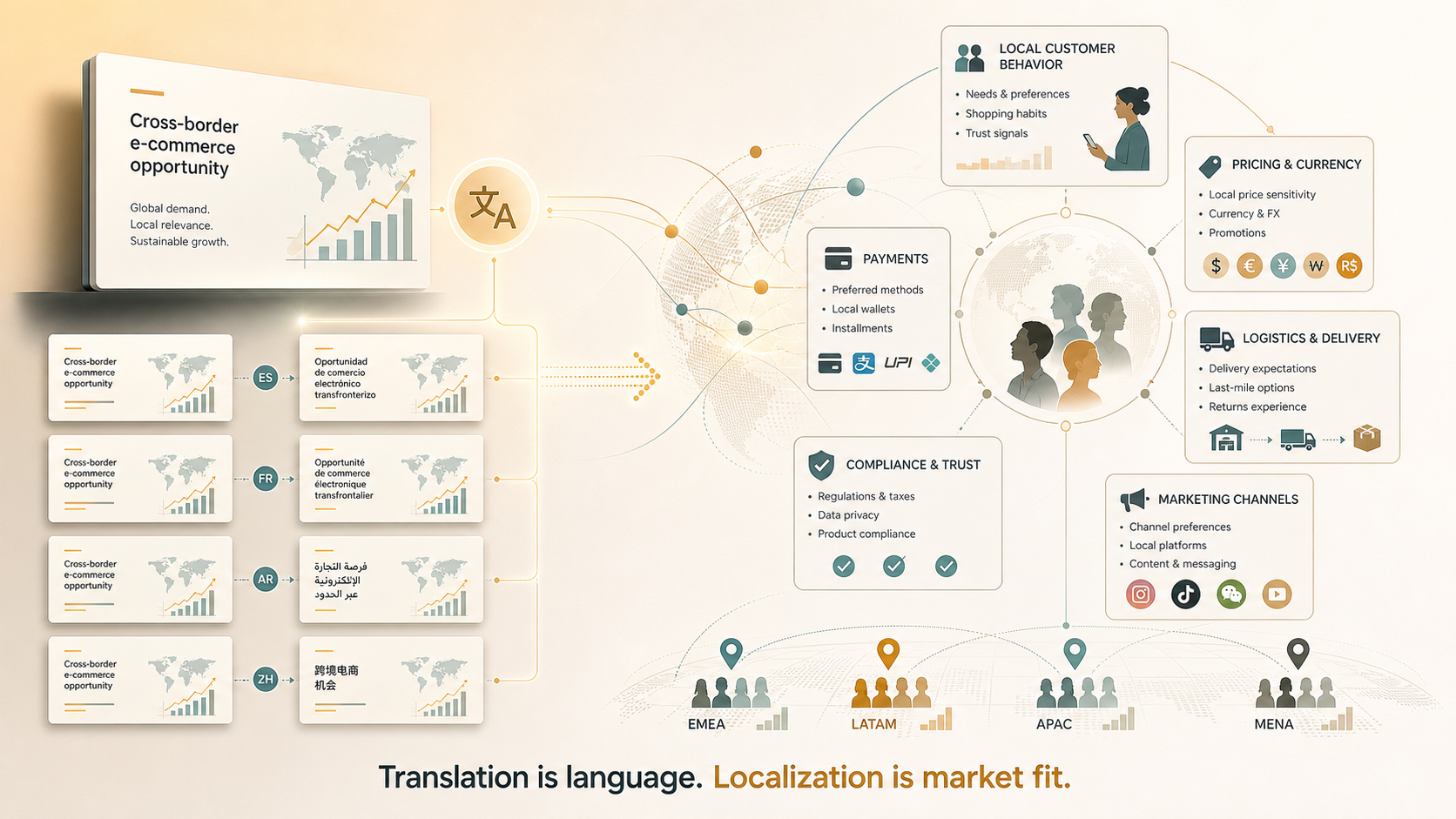
Pi is a strong fit when global ecommerce teams need to move from raw expansion ideas to a business-ready, multilingual presentation. It helps preserve the logic of the international business proposal while supporting the polish and adaptability required for high-stakes partner, investor, and executive conversations.
Frequently Asked Questions (FAQ)
Q: What should be included in a cross-border ecommerce presentation? A: A cross-border ecommerce presentation should include the expansion thesis, market opportunity, customer profile, product fit, localization plan, channel strategy, logistics model, payment approach, compliance considerations, financial projections, partnership ask, and next steps.
Q: How is a global expansion pitch deck different from a standard business proposal? A: A global expansion pitch deck must address regional market behavior, localization, logistics, payments, compliance, and partner expectations. A standard business proposal may explain the business model, but an international proposal must prove that the model can work in a specific market.
Q: Why do multi-language slide templates matter? A: Multi-language slide templates help teams keep strategy, terminology, and design consistent across markets. They also make it easier to adapt the deck for local audiences without rebuilding every slide or relying on direct translation alone.
Q: Can Pi help translate an international business proposal? A: Yes. Pi can support multilingual presentation workflows by helping teams structure, refine, and adapt business-ready decks for different languages and regions while maintaining professional visual quality and strategic consistency.
 Creative Agency Client Proposal Template: Winning B2B Deals with Aesthetics
 Management Consulting Report Template: Structuring Complex Business Logic