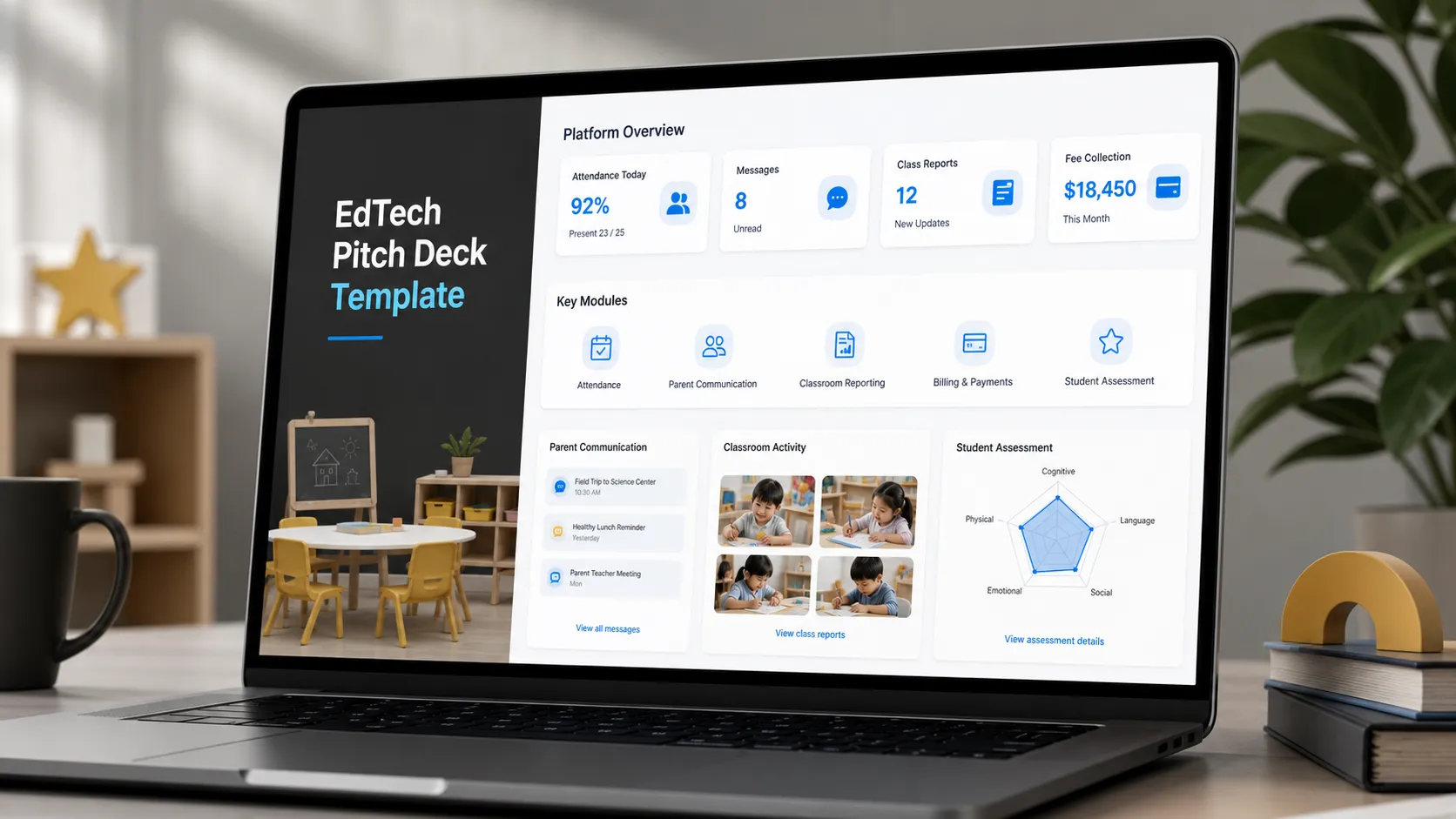
EdTech & Kindergarten Management Platform Pitch Deck Template
Launching an EdTech startup is difficult enough; explaining it clearly in a pitch deck is another challenge. A kindergarten management platform sits at the intersection of school operations, parent communication, child development, classroom reporting, and SaaS growth. That makes a generic education startup slides template too shallow for many real-world meetings.
A strong EdTech pitch deck for this category should help investors, school administrators, partners, and education groups understand not only what the product does, but why it matters. It must connect daily school pain points to measurable operational value, responsible student assessment data, and a credible business model.
This article explains how to structure an EdTech and kindergarten management presentation, what to include in the template, and how Pi can help turn a complex early education story into a polished, business-ready deck.
Why Kindergarten Management Platforms Need a Specialized Pitch Deck
Kindergarten management platforms are harder to pitch than many generic SaaS products because the buyer, user, and beneficiary are often different. A school owner may approve the purchase, teachers may use the system every day, parents may judge the experience, and children are the ultimate beneficiaries.
That means the deck must avoid oversimplifying the product as “school software.” It needs to show that the team understands the operational reality of early education:
- School administrators need attendance, billing, scheduling, and compliance visibility.
- Teachers need faster reporting workflows and less manual documentation.
- Parents need timely updates, trusted communication, and clearer insight into development.
- Operators need scalable processes across classrooms, campuses, or franchise networks.
- Investors need to see market opportunity, retention logic, and revenue quality.
The boundary is important: a kindergarten management platform is not only an app, and it is not only a learning tool. It is an operating layer for early education organizations. The pitch deck should reflect that broader role.
What an EdTech Pitch Deck Must Communicate
An effective EdTech pitch deck communicates a business story, not a feature inventory. The core narrative should begin with a specific pain: early education teams often rely on fragmented spreadsheets, messaging apps, paper reports, manual fee tracking, and inconsistent child development records. These disconnected workflows create stress for teachers, reduce transparency for parents, and limit management visibility.
The solution should then be presented as a unified platform that simplifies school operations while improving communication and assessment workflows. The deck should make the value concrete. For example, instead of saying “we offer attendance management,” the presentation can explain how digital attendance reduces manual checking, gives administrators real-time visibility, and supports parent notifications.
For investors, the deck should also translate product value into business logic. Who pays? Why do they renew? How does the platform expand across campuses? What makes adoption easier than legacy systems or manual processes? The stronger the link between product workflow and business performance, the more credible the deck becomes.
Recommended Slide Structure for the Template
A practical kindergarten management presentation should follow a sequence that reduces complexity and builds confidence. The goal is to guide the audience from problem to solution to growth potential.
Start with a concise opening slide that defines the company, target audience, and product category. Follow with a problem slide that shows the operational fragmentation in kindergartens and early education centers. The audience slide should clarify whether the platform serves independent kindergartens, preschool chains, childcare operators, education groups, or franchise networks.
The solution slide should show the platform as an integrated management system. Product slides can then cover the core modules: attendance, parent messaging, fee management, classroom reports, assessment tracking, teacher workflows, and administrator dashboards.
Include a student assessment radar chart slide if the product supports developmental tracking. This can show how the platform visualizes dimensions such as language, social skills, motor skills, creativity, and cognitive growth. After that, the deck should move into business model, traction, go-to-market strategy, team credibility, roadmap, and funding ask or partnership request.
How to Present Product Features Without Creating a Feature Dump
Many education startup slides become weak because they try to show every product capability at once. The result is a crowded deck that feels technical but not persuasive. A better approach is to frame features through user journeys and outcomes. https://www.nngroup.com/articles/visual-hierarchy-ux-definition/
For example, attendance tracking is not just a checkbox feature. It can be positioned as a workflow that helps teachers record attendance faster, administrators monitor classroom status, and parents receive timely updates. Parent messaging should not be presented as another chat function; it should be shown as a trust-building channel that reduces missed communication and improves school-parent visibility.
Fee management can be linked to fewer manual payment records and clearer revenue tracking. Classroom reports can be tied to teacher efficiency and more consistent parent communication. Assessment tracking can be explained as a structured way to organize observations, not as a claim that software alone improves learning outcomes.
This approach helps the audience understand why the platform matters in daily school life. It also helps the deck sound more strategic and less like a product brochure.
Using a Student Assessment Radar Chart in the Deck
A student assessment radar chart can be a useful visual when presented responsibly. In a kindergarten management presentation, it can show developmental dimensions https://www.cdc.gov/ncbddd/childdevelopment/screening.html in a compact, easy-to-read format. Common dimensions might include language development, social interaction, fine motor skills, gross motor skills, creativity, emotional expression, and cognitive growth.
The chart should not be treated as proof of learning improvement by itself. It is better positioned as a visualization tool that helps teachers and parents discuss development more clearly over time. The deck should explain the data source, whether it comes from teacher observations, curriculum milestones, periodic assessments, or structured classroom records.
For business relevance, the radar chart shows that the platform can create differentiated value beyond administration. It demonstrates how operational data and child development records may live in one system, helping schools deliver a more transparent and professional parent experience.
From Template to Investor-Ready Presentation with Pi
A template gives the deck a starting structure, but a high-stakes EdTech pitch often needs more than placeholder slides. Pi, short for Presentation Intelligence, is an AI presentation maker built for professional business presentations where logic, design quality, and audience readiness matter.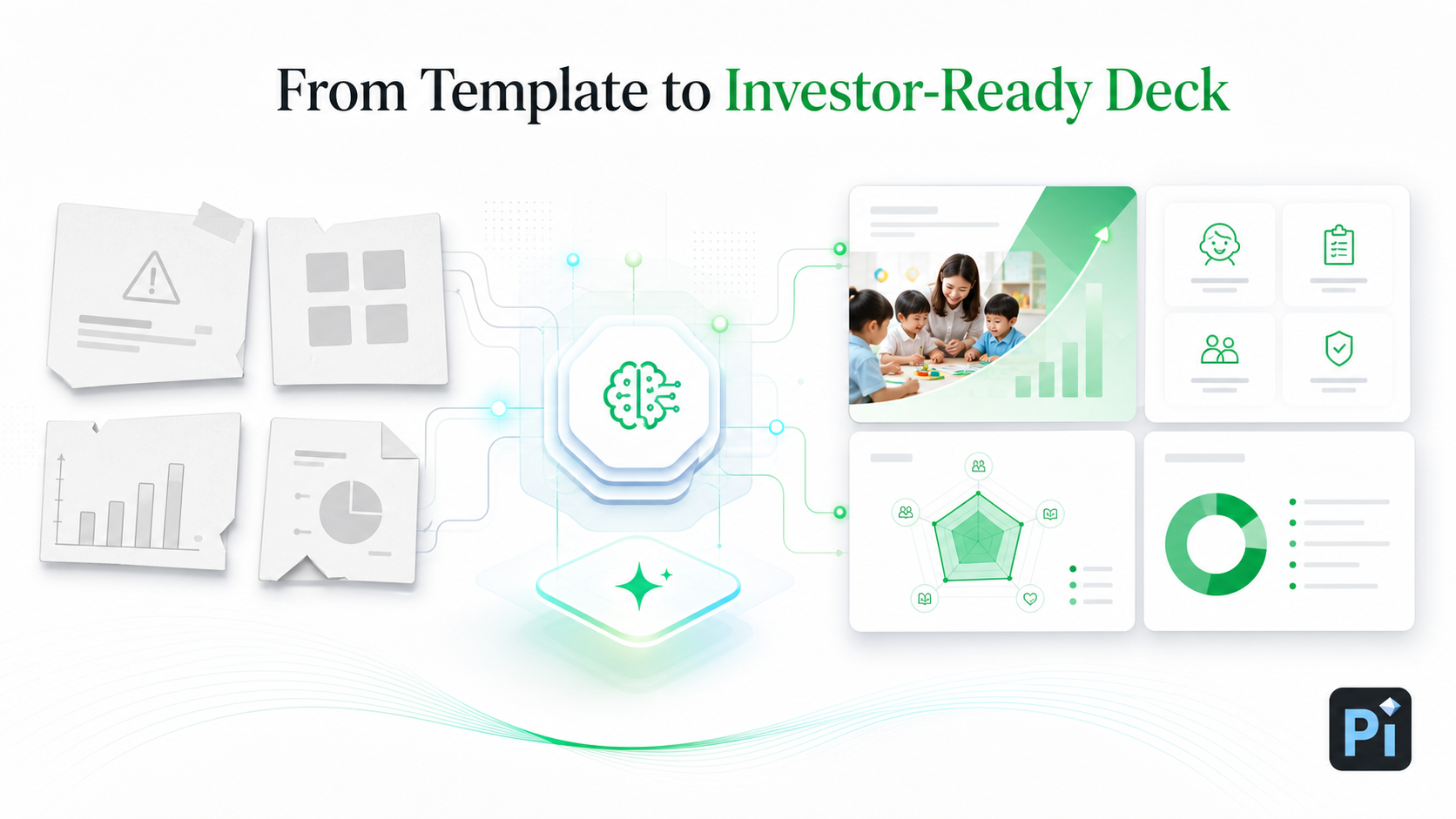
| Presentation Need | Basic Template | Pi |
|---|---|---|
| Slide structure | Provides a starting order | Builds a business-ready narrative |
| Product explanation | Lists modules | Connects features to workflows and outcomes |
| Visual quality | Depends on manual editing | Supports premium, business-grade aesthetics |
| Data storytelling | Adds charts | Frames charts in the pitch logic |
| Pitch readiness | Requires heavy refinement | Helps prepare for investor and stakeholder meetings |
1. Business Logic Comes Before Slide Styling
Pi helps teams shape the deck around the actual business case: the pain in kindergarten operations, the value for administrators and parents, the product’s differentiation, and the revenue model. This matters because a visually attractive EdTech pitch deck can still fail if the story feels scattered.
2. Multi-Agent AI Helps Organize Complex Messages
Kindergarten management platforms combine product, pedagogy, operations, data, and SaaS economics. Pi’s Multi-Agent AI workflow is designed to help manage that complexity, so the deck can balance educational credibility with commercial clarity.
3. Premium Visuals Support High-Stakes Meetings
For investor meetings, school administrator presentations, partner discussions, or strategic buyer conversations, the deck needs to feel polished. Pi supports premium visual quality and professional structure, helping teams move from rough template content to a more confident presentation experience.
Pitch Deck Quality Checklist
Before using the deck in a serious meeting, review whether each slide earns its place. The problem should be specific to early education operations, not a generic “schools need digital transformation” statement. The audience should be sharply defined, and the solution should be easy to understand within a few minutes.
The product section should connect features to outcomes. The student assessment radar chart should be clear, responsibly interpreted, and relevant to the platform’s value. The business model should explain pricing logic, renewal potential, and expansion opportunities. Traction should be credible, even if early, and the funding ask or partnership request should be direct.
Visual consistency also matters. A kindergarten management pitch deck can feel warm and education-oriented while still looking professional. Avoid overly childish design if the meeting is with investors or institutional partners. The tone should balance trust, care, operational discipline, and growth potential.
Best Fit: Who Should Use This Template
This EdTech pitch deck template is best suited for founders, product marketers, and operators building kindergarten management platforms, preschool SaaS tools, childcare administration systems, or early education communication platforms.
It can also support incubator participants preparing demo day presentations, school groups evaluating new digital products, and education teams pitching strategic partners. The structure works for investor-facing decks, but it is not limited to fundraising. With slight adjustments, the same foundation can support school administrator meetings, channel partnership presentations, and internal product strategy discussions.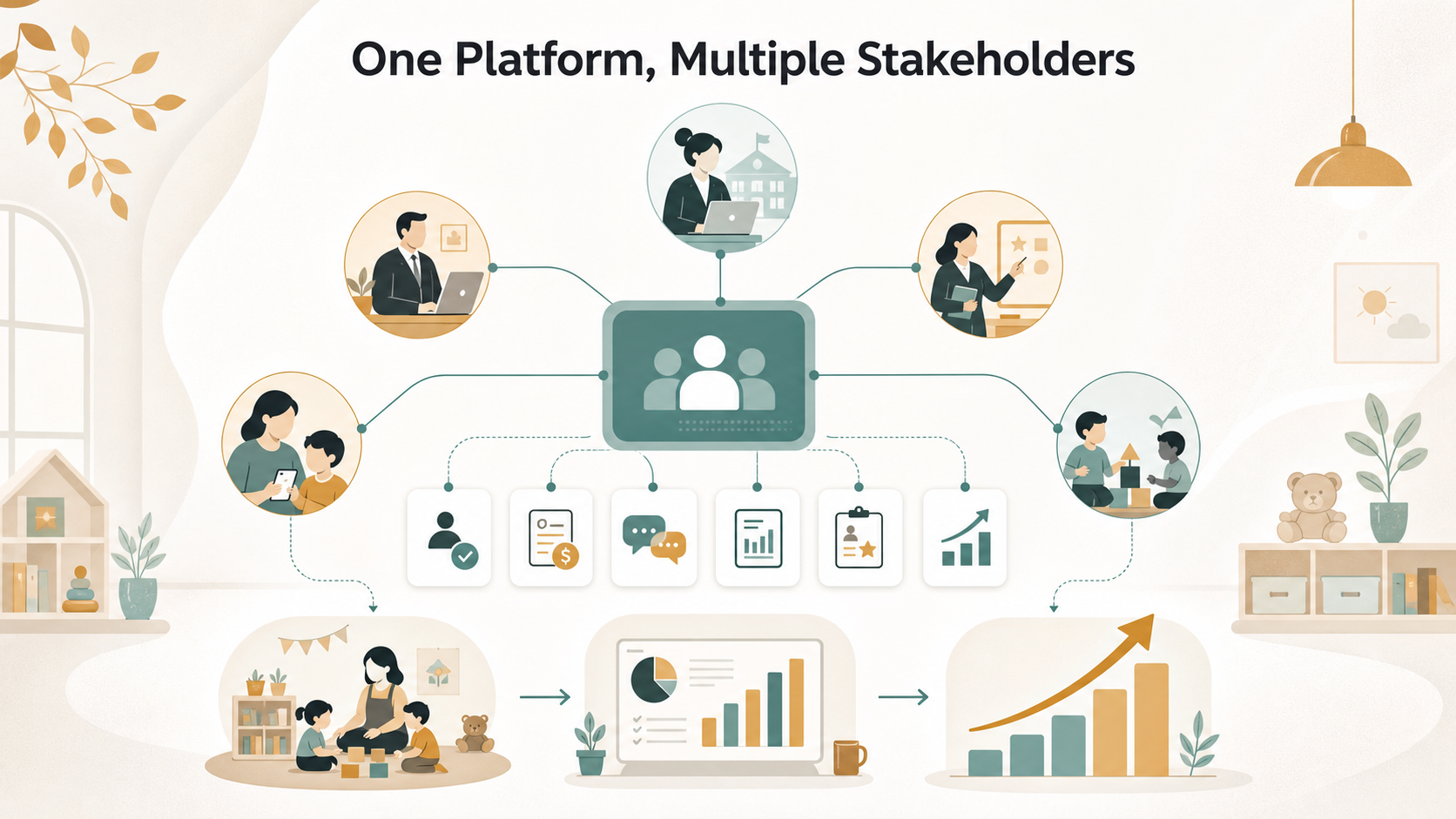
The best users are teams that need to explain a product with multiple stakeholders and multiple layers of value. If your platform touches school operations, parent engagement, classroom reporting, and child development data, a specialized deck will communicate your story more effectively than a generic startup template.
Frequently Asked Questions (FAQ)
Q: What should an EdTech pitch deck for a kindergarten management platform include? A: It should include the problem, target audience, solution, product workflows, student assessment visuals, business model, traction, go-to-market strategy, team, and funding ask or partnership request.
Q: How is a kindergarten management presentation different from a general education startup deck? A: It must address school operations, teacher workflows, parent communication, child development tracking, and business scalability at the same time. A general EdTech deck may not cover that full operational complexity.
Q: Should I include a student assessment radar chart in my pitch deck? A: Yes, if your product genuinely supports developmental tracking. Use it to visualize dimensions such as language, motor skills, social skills, creativity, and cognitive growth, but avoid claiming that the chart alone proves learning outcomes.
Q: How can Pi help create a better EdTech pitch deck? A: Pi helps turn a template into a more structured, professional presentation by improving business logic, organizing complex product messages, and applying premium visual quality for investor, school, partner, or stakeholder meetings.
 Creative Agency Client Proposal Template: Winning B2B Deals with Aesthetics
 Management Consulting Report Template: Structuring Complex Business Logic