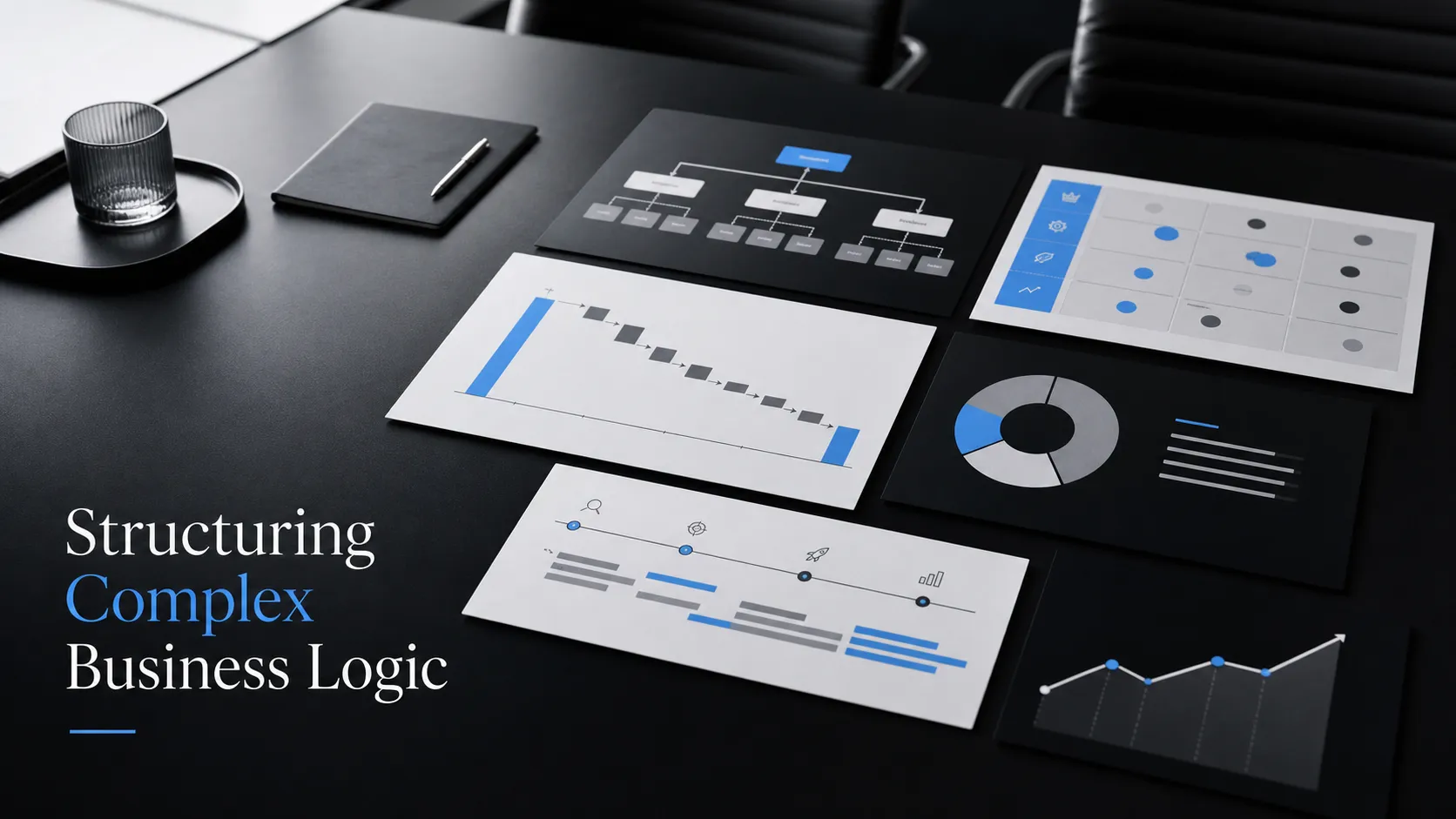
Management Consulting Report Template: Structuring Complex Business Logic
A strong management consulting presentation is not simply a collection of attractive slides. It is a structured argument that helps decision-makers understand what is happening, why it matters, what choices are available, and what action should come next.
That is why a useful management consulting report template must do more than provide a clean layout. It needs to help teams organize business logic. Whether you are preparing a business strategy report slide, a transformation roadmap, a market entry recommendation, or an executive advisory deck, the real challenge is turning complex analysis into a clear decision narrative.
This guide outlines a practical consulting report structure and explains how Pi, short for Presentation Intelligence, can support a more business-ready workflow for AI consulting templates and professional PPT creation.
Why Consulting Reports Need More Than Polished Slides
Many consulting-style decks look organized at first glance. They use restrained colors, tidy charts, executive summaries, and concise headers. But visual polish does not guarantee strategic clarity.
A consulting report fails when the audience cannot follow the logic. Executives may understand the data, but still be unsure which conclusion matters most. They may see multiple analyses, but not the recommendation. They may recognize the problem, but not know what decision is required.
This is the boundary of many static templates. They help with format, but not always with reasoning. A deck can resemble McKinsey style slides in visual tone without achieving the same level of analytical discipline. The goal is not to copy any proprietary consulting method. The goal is to build a clear, evidence-based business argument.
What Makes a Management Consulting Report Executive-Ready
An executive-ready consulting report usually has five qualities.
First, it defines the issue clearly. The report should make the business question visible early, not hide it behind background information. Second, it uses structured logic. Each section should answer a specific part of the overall problem. Third, it separates evidence from interpretation. Data is useful, but insight comes from explaining what the data means.
Fourth, it shows recommendation discipline. A consulting report should not present endless options without judgment. It should help leaders compare choices and understand trade-offs. Finally, it should be sequenced for decisions. The audience should move naturally from context to diagnosis, from diagnosis to options, and from options to action.
This is what separates a professional management consulting presentation from a general business update.
A Practical Management Consulting Report Template
A reliable management consulting report template typically begins with an executive summary. This section should state the core finding, the recommended action, and the expected business impact. It is not a teaser; it is the answer upfront.
The next section provides context. This may include market shifts, company performance, customer behavior, operational constraints, or competitive dynamics. The purpose is to explain why the issue matters now.
After context, define the key question. For example: Should the company enter a new market? Which customer segment should be prioritized? What operating model will improve margins? A precise question keeps the report from becoming a broad research document.
The diagnostic analysis follows. This section examines root causes, performance gaps, market evidence, financial drivers, customer needs, or organizational barriers. It should not include every analysis performed, only the analysis needed to support the decision.
Then present strategic options. Each option should be meaningfully different, not a minor variation of the same idea. Compare options against criteria such as ROI, risk, execution complexity, market fit, and strategic alignment.
The recommendation section should make the preferred path explicit. It should explain why this option is stronger than the alternatives and what conditions must be true for success.
Finally, include an implementation roadmap, major risks, mitigation actions, and next steps. Executives need to know not only what should happen, but also how the organization can move from recommendation to execution.
How to Structure Complex Business Logic on Slides
The most effective business strategy report slide usually has one central message. A slide should not ask the audience to inspect every detail and infer the point. The headline should communicate the insight, while the body of the slide proves it.
Consulting-style sequencing often follows a pyramid principle approach: start with the answer, then support it with grouped arguments and evidence. In practice, this means the deck should not merely describe the work completed. It should guide the audience through a line of reasoning.
Action titles are especially important. Instead of writing “Market Analysis,” write “Enterprise demand is growing fastest in regulated industries.” Instead of “Cost Review,” write “Three cost pools account for 72% of margin pressure.” These headlines make the logic visible.
Evidence hierarchy https://www.nngroup.com/articles/visual-hierarchy-ux-definition/ also matters. The strongest slides distinguish between the key takeaway, supporting data, and secondary detail. Charts, tables, and frameworks should serve the argument, not compete with it.
Consulting Report Component Table
| Report Section | Strategic Purpose | Common Slide Output |
|---|---|---|
| Executive Summary | State the answer and decision required | Recommendation overview |
| Business Context | Explain why the issue matters now | Market or performance snapshot |
| Key Question | Define the decision frame | Problem statement slide |
| Diagnostic Analysis | Identify root causes and drivers | Issue tree, chart, or framework |
| Strategic Options | Compare possible paths | Option evaluation matrix |
| Recommendation | Commit to the preferred direction | Recommendation slide |
| Implementation Roadmap | Translate strategy into action | Timeline or workstream plan |
| Risks and Mitigations | Prepare leaders for uncertainty | Risk register or mitigation map |
| Next Steps | Clarify ownership and momentum | Action plan slide |
Where Static Templates Start to Break Down
Static templates are helpful when the structure is already known. They can save time, standardize formatting, and give teams a professional starting point. The challenge begins when the business situation is ambiguou
Templates often struggle when teams need to:
- Synthesize messy inputs from documents, interviews, spreadsheets, and notes
- Decide which analysis belongs in the main storyline versus the appendix
- Adapt the narrative for a board, client, investor, or internal leadership team
- Convert raw findings into a recommendation with clear trade-offs
In these moments, the issue is not slide design alone. The harder task is shaping business logic.
How Pi Helps Build AI Consulting Templates with Business Logic
Pi is an AI presentation maker and AI PPT generator built for professional business presentations. For consulting reports, its value is not simply generating slides faster. Pi is designed to support the deeper workflow behind executive-ready decks: structure, reasoning, content refinement, and premium visual quality. https://www.ibm.com/think/topics/multiagent-system 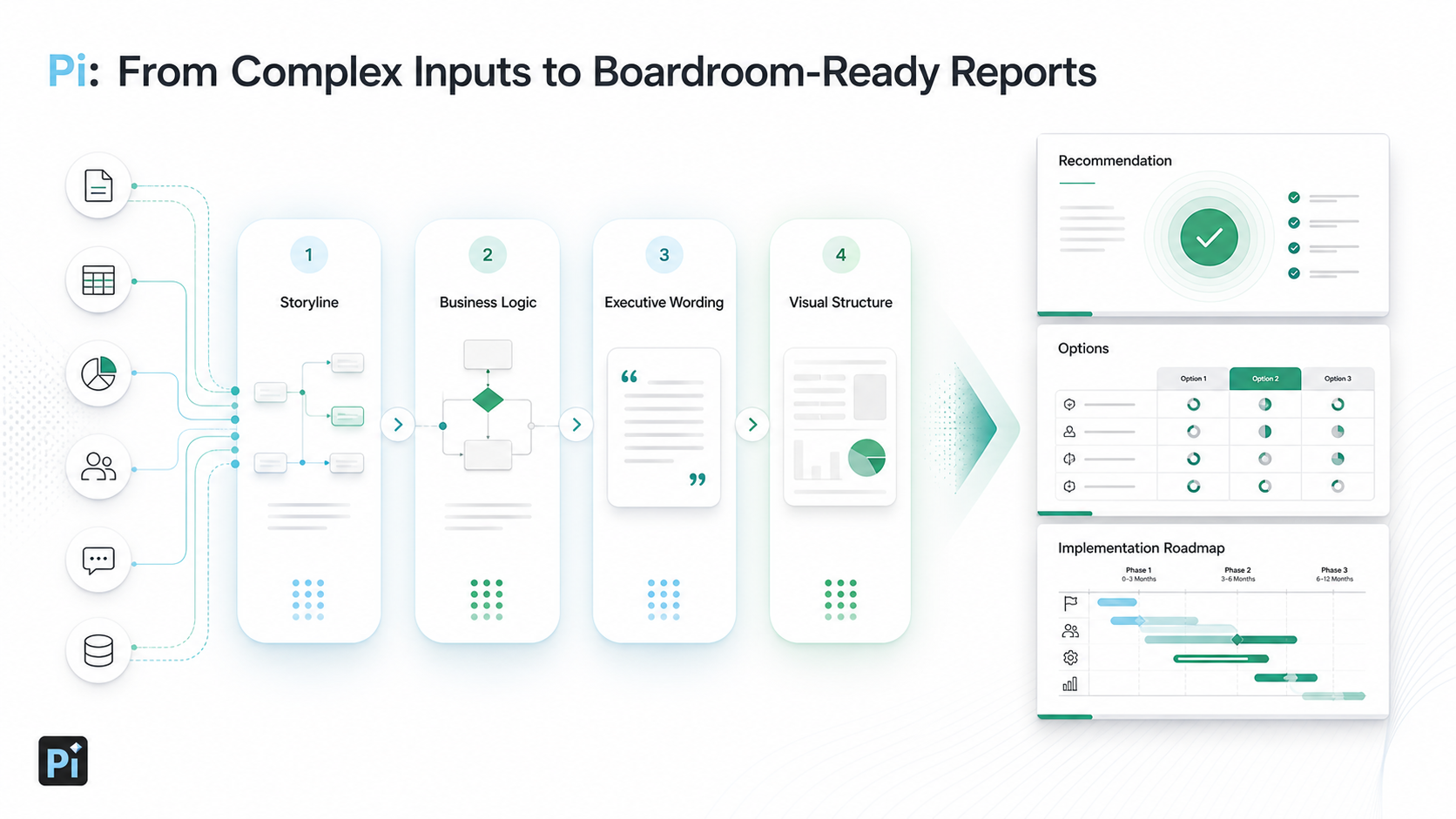
1. Business Logic Comes Before Slide Styling
A consulting report should begin with the argument, not the layout. Pi helps teams move from raw complexity toward a clearer presentation structure by supporting the flow from context to insight, recommendation, and action.
This is especially useful for strategy teams, consultants, founders, and business leaders who need to turn analysis into a management consulting presentation that feels coherent rather than assembled slide by slide.
2. Multi-Agent AI Supports Different Parts of the Report
Pi uses Multi-Agent AI to assist across different layers of the presentation workflow. One layer may help shape the storyline. Another may support content refinement, slide hierarchy, or executive wording. Another may help improve the visual structure of the deck.
This does not replace expert judgment, data validation, or client-specific analysis. Instead, it helps professionals work through the presentation-building process with more structure and less friction.
3. Premium Visual Quality Makes the Report Boardroom-Ready
Once the business logic is clear, visual execution still matters. A consulting report should feel controlled, credible, and easy to scan. Pi supports premium, business-grade aesthetics so that the final PPT does not look like a generic AI output.
For high-stakes consulting reports, the combination of logic and polish is essential. The deck must look professional, but it must also make the recommendation easier to understand.
When to Use This Template
This management consulting report template is useful for strategy reviews, market research decks, transformation plans, executive presentations, client advisory reports, operating model recommendations, and internal decision papers.
It is also useful when teams are trying to create McKinsey style slides in the broader sense: concise, structured, insight-led, and decision-oriented. The focus should be on clarity of thinking, not imitation. A good AI consulting template should help you organize the business argument while leaving room for expert review and customization.
A Better Way to Build Consulting Reports
The best consulting report template is not just a slide format. It is a thinking structure. It helps teams clarify the problem, organize evidence, compare options, and recommend action with confidence.
Static templates can provide a useful foundation. But when the material is complex, the real value comes from a workflow that helps shape the logic behind the slides. Pi is built for that deeper layer of professional presentation work, helping teams create consulting-style reports that are structured, polished, and ready for serious business conversations.
Frequently Asked Questions (FAQ)
Q: What should a management consulting report template include? A: It should include an executive summary, business context, key question, diagnostic analysis, strategic options, recommendation, implementation roadmap, risks, and next steps. The structure should support decision-making, not just organize information.
Q: How are McKinsey style slides different from normal business slides? A: McKinsey style slides are often associated with clear action titles, structured logic, strong evidence hierarchy, and concise executive communication. The goal is not to copy proprietary materials, but to make business reasoning easier to follow.
Q: Can AI help create a consulting presentation? A: Yes. AI can help structure the storyline, refine slide content, improve hierarchy, and accelerate PPT creation. However, expert judgment, validated data, and client-specific insight remain essential.
Q: How does Pi support AI consulting templates? A: Pi supports consulting-style presentations through Multi-Agent AI, business-ready structure, and premium visual quality. It helps professionals turn complex inputs into a clearer, more executive-ready management consulting presentation.
 Creative Agency Client Proposal Template: Winning B2B Deals with Aesthetics
 Management Consulting Report Template: Structuring Complex Business Logic