East Meets West: Crafting Visually Stunning Presentations for Global Audiences
A presentation starts communicating before anyone reads the first headline. Color, spacing, imagery, hierarchy, chart style, and even the amount of text on a slide all send cultural signals. In a global business setting, those signals can either create confidence or introduce friction.
That is why cross-cultural presentation design is not simply translation with a new title page. A global pitch deck, international business slides, or executive proposal must feel credible to the audience in front of you while still protecting the core brand and message. The strongest global decks are not generic. They are strategically localized.
Why Cross-Cultural Presentation Design Matters
In international business, design affects how people judge clarity, authority, relevance, and professionalism. A pitch deck for investors in one market may need a different visual rhythm than a client proposal for a procurement team in another. A sales deck for a regional leadership group may require different proof points, examples, and data emphasis than the same deck used at headquarters.
This does not mean every country needs a completely different presentation style. It means visual decisions should be made with audience context in mind. Cross-cultural presentation design helps teams avoid the two most common problems: slides that feel foreign to the audience, and slides that lose brand consistency through over-adaptation.
For global teams, the goal is to make the deck feel both familiar and polished. That requires more than changing language. It requires attention to how people scan slides, interpret visuals, evaluate data, and connect business claims to local realities.
The Real Challenge: Consistency Without Cultural Flattening
The central challenge is balance. A multinational brand cannot redesign itself for every meeting, but it also cannot assume that one visual system will land equally well everywhere. The solution is not to replace one design culture with another. It is to create a flexible system that keeps the strategic message stable while adapting the presentation experience.
A strong localization design approach should protect:
- The core business argument and narrative flow
- Brand identity, including logo, typography, and tone
- Market-specific expectations around clarity, proof, and formality
- Slide readability after translation or regional adaptation
- Visual credibility for the decision-makers in the room
This is where many teams struggle. They either translate the text and keep every slide unchanged, or they over-customize until the presentation no longer feels like the same company. The best global presentation design sits between those extremes.
Design Variables That Change Across Markets
Color is one of the first elements teams notice, but it is only one part of the system. Colors can carry different emotional, cultural, or category associations across regions. A color that feels premium in one market may feel too aggressive, too casual, or too muted in another. Rather than relying on assumptions, teams should check whether key colors support the intended business tone in the specific context.
Information density also matters. Some audiences may expect more visible evidence on the slide, while others may prefer a cleaner slide supported by verbal explanation. This is not a simple East-versus-West rule. It depends on industry, seniority, meeting format, and the decision being made. A technical committee, for example, may need more detail than a board-level audience regardless of geography.
Whitespace, hierarchy, https://www.nngroup.com/articles/visual-hierarchy-ux-definition/ and layout rhythm influence how quickly an audience understands the message. If a translated headline expands by 40 percent, the original layout may break. If a chart label becomes longer in another language, the data visualization may become harder to read. Localization design must account for text expansion, https://www.w3.org/International/articles/article-text-size.en line breaks, and reading patterns early, not after the deck is finished.
Imagery and symbols deserve similar care. Stock photos, hand gestures, icons, metaphors, and office scenes can feel natural in one context and irrelevant in another. A global pitch deck should use visuals that support the audience’s business reality, not just the brand’s original market.
How to Adapt a Global Pitch Deck Without Losing the Message
The best workflow begins with the argument, not the decoration. Before changing visuals, clarify what the deck must achieve. Is it meant to raise capital, win a client, align executives, launch a product, or explain a market strategy? Once the outcome is clear, identify which parts of the deck are universal and which parts need local adaptation.
The core narrative should usually remain stable: problem, insight, solution, proof, economics, implementation, and next step. What changes are the examples, benchmarks, customer references, market data, and visual framing. A global pitch deck becomes more persuasive when local proof points are built into the story rather than added as an appendix.
Teams should also review the deck after translation in the actual slide format. A paragraph that looks concise in English may become too long in German, Spanish, French, or another language. A short product phrase may expand and push against a chart or image. Good international business slides anticipate these changes with flexible layouts, modular content blocks, and clear hierarchy.
| Presentation Need | One-Style Global Deck | Localized Global Deck |
|---|---|---|
| Brand consistency | Strong but rigid | Strong and adaptable |
| Audience relevance | Uneven by market | Tuned to local context |
| Visual credibility | Depends on fit | Reviewed for cultural fluency |
| Translation handling | Often retrofitted | Built into layout planning |
| Business persuasion | Message may feel distant | Message feels closer to decision-makers |
Where Pi Helps Global Teams Build Localized Business Slides
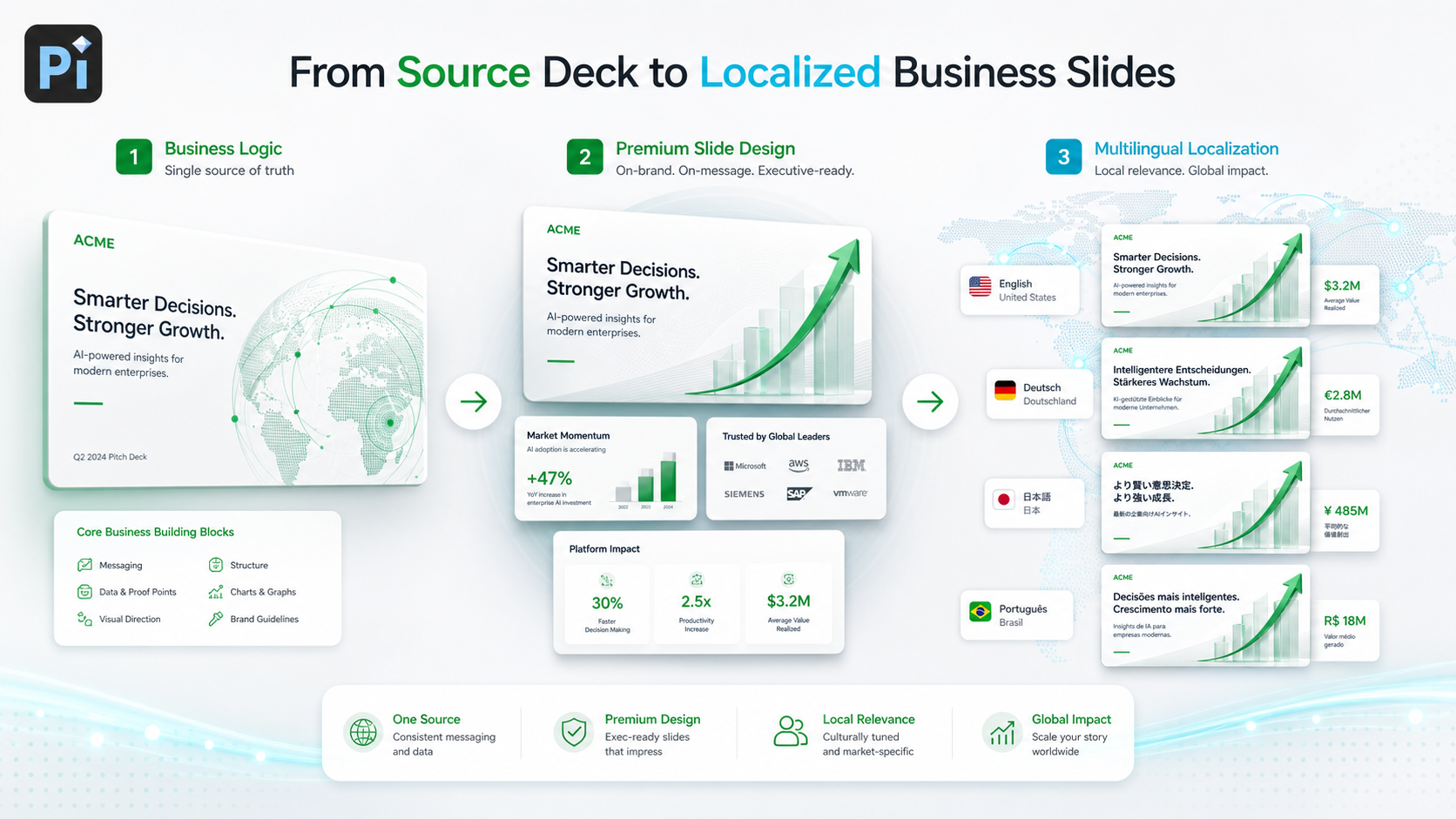
Pi, short for Presentation Intelligence, is an AI presentation maker for professional business presentations. For global teams, its value is not only generating slides faster. It helps connect business logic, premium visual quality, and multilingual presentation workflows so teams can move from a single-market deck to a more audience-aware version.

1. Business Logic Comes Before Slide Styling
Localization should never start with “change the colors.” It should start with the business argument. Pi supports a structure-first workflow, helping teams shape the deck around the audience, use case, and decision goal. That matters for pitch decks, sales decks, consulting reports, executive presentations, and brand proposals where the flow of logic is as important as the slide design.
With Pi, teams can work from a clearer narrative foundation before adapting visuals. This reduces the risk of producing beautiful slides that do not answer the local audience’s real questions.
2. Premium Visual Quality Across Different Audience Contexts
A localized deck should not look like a patched version of the original. It should feel intentional. Pi is built for premium, business-grade aesthetics, helping teams maintain a polished look while adjusting layout density, visual emphasis, chart treatment, and content hierarchy for different markets.
This is especially useful when teams need executive-ready decks under time pressure. Instead of manually redesigning every slide, teams can focus on strategic adjustments: which proof points to highlight, which visuals need replacement, and where the deck should feel more formal, more concise, or more evidence-led.
3. Multilingual Support for Cross-Border Teams
Multilingual presentation work creates practical design challenges. Translated text changes length. Slide titles may need restructuring. Formatting must remain consistent across versions. Regional teams may also need to collaborate on examples, customer language, or compliance-sensitive statements.
Pi supports global and multilingual teams by making localization part of the presentation workflow rather than an afterthought. The result is a cleaner path from source deck to localized business slides, with stronger structure and visual consistency across languages.
A Practical Checklist for International Business Slides
Before presenting to a global audience, review the deck through both a business and design lens. Ask whether the story still works for this audience, whether the examples feel relevant, and whether the visuals support the intended level of trust.
Check color meanings and category conventions in the target market. Review imagery for relevance and professionalism. Confirm that charts, icons, and symbols are easy to understand without local confusion. Test translated slides for text expansion, broken layouts, and weakened hierarchy. Replace generic proof points with market-specific data where possible. Finally, make sure the deck still works for senior decision-makers who may scan quickly and focus only on the most important slides.
A useful rule is simple: if the audience can understand the logic faster and feel that the presentation was made with them in mind, the localization is working.
The Best Global Decks Feel Native and Strategic
A visually stunning global presentation does not come from applying one universal style everywhere. It comes from disciplined adaptation. The strongest decks preserve the business message, maintain brand trust, and adjust the visual experience so the audience can engage without unnecessary friction.
For professional teams, cross-cultural presentation design is now a core business skill. It affects how investors interpret confidence, how clients evaluate credibility, and how executives decide whether a recommendation feels actionable. Pi helps teams approach that challenge with stronger structure, premium aesthetics, and multilingual support, making localized presentations feel less like translation work and more like strategic communication.
Frequently Asked Questions (FAQ)
Q: What is cross-cultural presentation design? A: Cross-cultural presentation design is the practice of adapting slide visuals, layouts, examples, language, and proof points for audiences in different cultural or regional contexts while keeping the core business message consistent.
Q: How is a global pitch deck different from a translated pitch deck? A: A translated pitch deck changes the language. A global pitch deck also adapts visual hierarchy, examples, data, imagery, tone, and layout so the presentation feels relevant and credible to the target audience.
Q: Should presentation visuals change for every country? A: Not always. Some brand elements should remain consistent. However, teams should review colors, imagery, information density, proof points, and translated text length for each important market or audience segment.
Q: How can Pi help with international business slides? A: Pi helps teams build professional, multilingual, business-ready presentations with clear structure, premium visual quality, and workflows that support localization across global pitch decks, sales decks, executive presentations, and client proposals.
 Creative Agency Client Proposal Template: Winning B2B Deals with Aesthetics
 Management Consulting Report Template: Structuring Complex Business Logic