Designing for Luxury: How to Achieve Premium Aesthetics in Your Brand Proposals
In luxury sales, design is not a finishing touch. It is part of the value signal. Before a buyer reads the pricing model, evaluates the campaign idea, or reviews the partnership structure, the presentation has already communicated something: whether the team understands taste, restraint, confidence, and detail.
A luxury brand presentation has to do more than look attractive. It must make the opportunity feel considered, the brand world feel coherent, and the commercial proposal feel worthy of serious attention. For fashion, beauty, hospitality, premium lifestyle, and high-end consumer brands, the deck itself becomes evidence of the team’s judgment.
That is why premium slide design requires a different standard. It is not about decorating slides until they feel expensive. It is about building a proposal where every visual decision supports the story, the audience, and the business goal.
Why Luxury Brand Presentations Need a Different Design Standard
 Ordinary business decks often prioritize speed, density, and completeness. They may use default layouts, crowded charts, mixed typography, and generic stock imagery because the goal is simply to communicate information. That approach can work for internal updates, but it often fails in luxury contexts.
Premium audiences expect the presentation to feel curated, not assembled. They notice spacing, image quality, page rhythm, typography, and whether the proposal understands the brand’s visual language. A single cluttered slide can reduce the perceived sophistication of the entire offer.
The boundary is clear:
- A standard business deck explains the idea.
- A luxury brand presentation elevates the idea.
- A generic template creates consistency.
- A premium proposal creates intention.
- A decorative deck looks styled.
- A high-end proposal feels edited.
This matters because luxury positioning depends on perception. If the deck feels rushed, inconsistent, or template-driven, the proposal may weaken the very value it is trying to sell.
The Difference Between Expensive-Looking and Truly Premium Design
Many teams confuse luxury with visual drama. They add gold accents, oversized serif type, black backgrounds, dramatic photography, and ornamental details. Sometimes those choices are appropriate, but they do not automatically create premium design.
Expensive-looking design often depends on surface signals. Truly premium slide design depends on discipline. It uses proportion, hierarchy, https://www.nngroup.com/articles/visual-hierarchy-ux-definition/ and restraint to make the audience feel that every element has been chosen deliberately.
Premium design is usually quieter than expected. It gives strong ideas room to breathe. It avoids showing everything at once. It treats silence, margin, and pacing as design assets. The result is not an empty deck; it is a controlled one.
A luxury proposal should feel confident enough not to over-explain. It should guide the audience through the brand logic, commercial opportunity, and creative direction with clarity. The visual system should amplify that argument rather than compete with it.
The Core Elements of Premium Slide Design
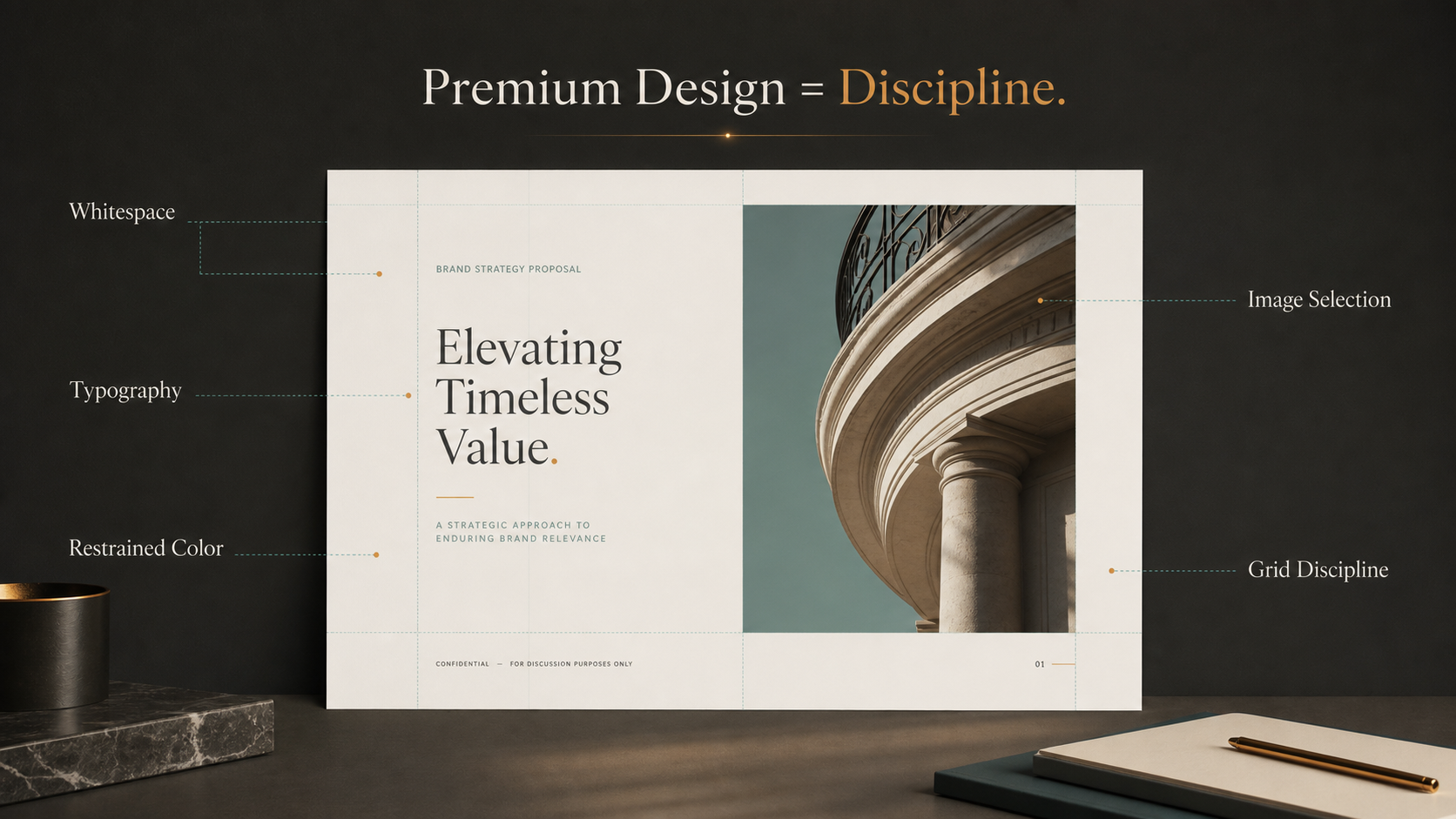
Whitespace is one of the most important signals of luxury. Generous margins and open layouts suggest confidence, while crowded pages suggest uncertainty. In a premium proposal, fewer elements per slide often create more authority.
Typography should feel editorial and consistent. A refined type system may use one strong display style, one readable body style, and clear rules for captions, numbers, and labels. What matters most is consistency. Random font changes make a deck feel improvised.
Color should be restrained. A luxury brand presentation does not need many colors to feel rich. Often, one dominant neutral palette with one or two controlled accents is more effective than a broad decorative range. Contrast should be strong enough for readability but not so harsh that it breaks the mood.
Image selection is equally important. Premium decks need photography and visuals that carry narrative purpose. A beautiful image is not enough if it does not support the audience insight, product world, campaign concept, or brand positioning. Cropping, scale, and placement should feel intentional.
Grid discipline creates invisible quality. Aligned edges, consistent spacing, repeated margins, and balanced compositions help the audience trust the presentation even if they cannot name why it feels polished. Luxury design often works because the details are controlled.
How to Structure a High-End Brand Proposal
A fashion brand proposal or luxury brand proposal should not read like a lookbook with pricing attached. It needs both atmosphere and business logic. The audience should understand not only the aesthetic direction but also why the proposal makes commercial sense.
A strong structure usually begins with brand context. This frames the market, the cultural moment, or the specific challenge the brand is facing. From there, the proposal should introduce audience insight: who the target customer is, what they value, and what emotional or practical barrier the idea addresses.
The concept section should then define the creative territory. This is where mood, language, references, product emphasis, and experience design begin to connect. A premium proposal should avoid vague statements such as “elevated experience” unless the deck explains what that means in execution.
The offer should be clear. Whether the proposal is for a campaign, collaboration, retail activation, product launch, sponsorship, or brand partnership, the audience needs to understand the scope. Execution planning should show how the idea becomes real, while the commercial value section should connect the work to business outcomes such as awareness, conversion, loyalty, customer acquisition, or brand equity. https://hbr.org/1993/01/customer-based-brand-equity
Finally, the next steps should feel decisive. Luxury does not mean unclear. The final business movement of the deck should make it easy for the audience to act.
Where High-End Pitch Deck Templates Fall Short
A high-end pitch deck template can be useful as a starting point. Templates help create visual consistency, reduce formatting time, and prevent basic design mistakes. For teams that need a polished foundation quickly, they can provide helpful structure.
The challenge begins when the template becomes the strategy. Luxury proposals often require custom pacing, brand-specific visual language, and judgment about what to show, hide, emphasize, or simplify. A template may provide beautiful layouts, but it cannot automatically understand the emotional codes of a heritage fashion house, the commercial priorities of a beauty launch, or the nuance of a hospitality partnership.
| Presentation Need | High-End Pitch Deck Template | Pi |
|---|---|---|
| Visual consistency | Provides preset layouts | Supports polished, flexible structure |
| Brand specificity | Requires manual adaptation | Helps shape deck around context |
| Business logic | Often depends on user input | Builds around proposal goals |
| Premium pacing | Limited by fixed slide types | Allows more tailored flow |
| Final refinement | May need heavy editing | Supports business-grade polish |
Templates are not the problem. Over-reliance is. A premium proposal needs enough structure to feel coherent and enough flexibility to feel made for this exact brand, audience, and business moment.
How Pi Helps Create Premium Brand Proposals Without Rigid Templates
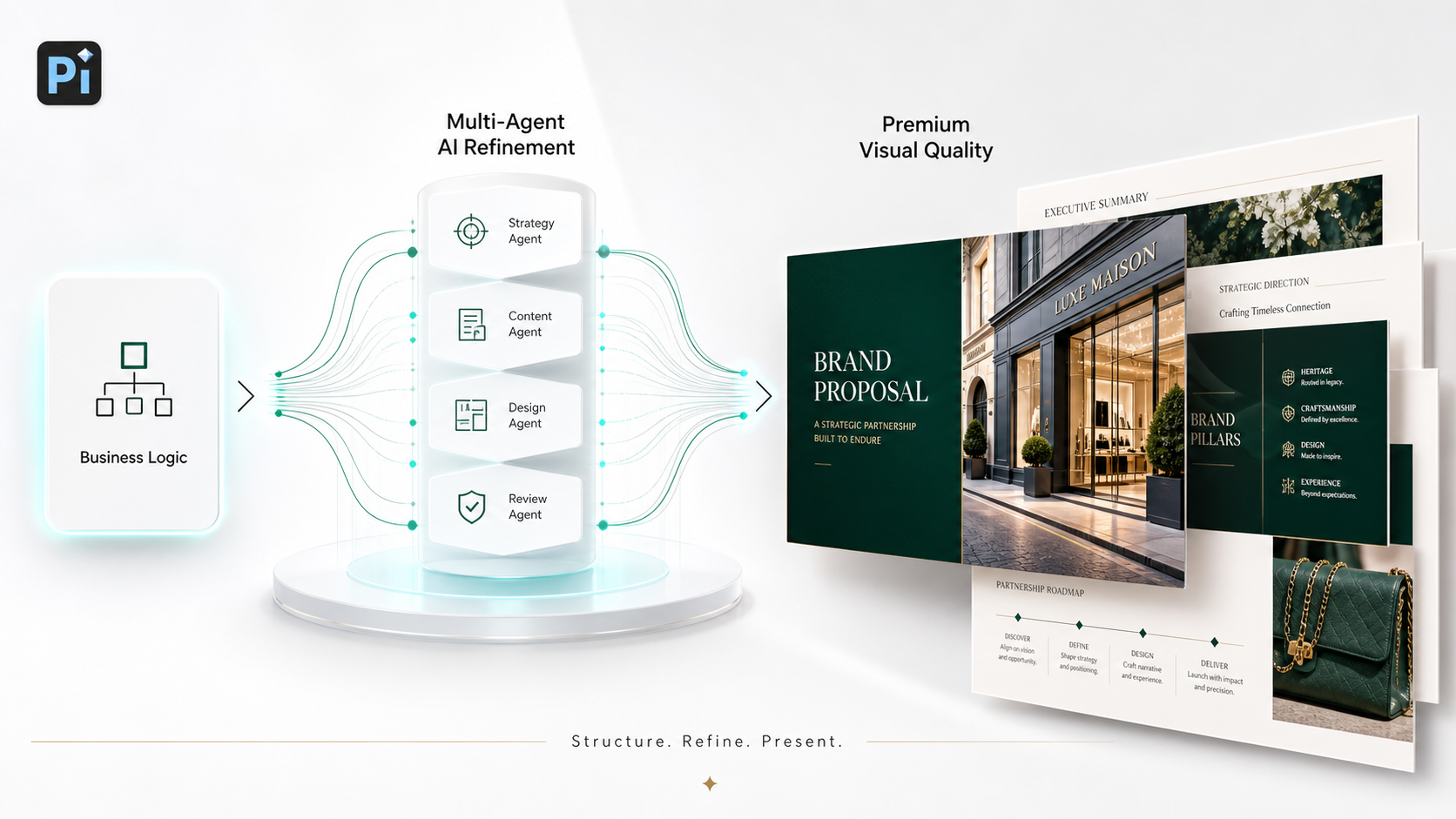
Pi, short for Presentation Intelligence, is an AI presentation maker designed for professional business presentations where structure and aesthetics both matter. For luxury proposals, that combination is important. The deck cannot be only beautiful, and it cannot be only logical. It needs both.
1. Business Logic Comes Before Slide Styling
Pi helps teams organize a proposal around the business goal before focusing on surface design. That matters because premium aesthetics are most persuasive when the underlying argument is clear.
Instead of simply turning text into slides, Pi supports the development of a business-ready structure: context, insight, concept, execution, value, and next steps. This helps teams avoid the common luxury proposal mistake of building an attractive deck that lacks decision-making clarity.
For a fashion brand proposal, that could mean connecting the creative idea to audience behavior, product positioning, seasonal timing, and measurable outcomes. The visual language then supports the strategy rather than replacing it.
2. Multi-Agent AI Supports a More Refined Workflow
Pi’s Multi-Agent AI helps move the workflow beyond a basic first draft. Different parts of the presentation process require different kinds of judgment: structuring the story, refining the message, organizing evidence, and shaping the design direction.
This is especially useful for premium slide design because luxury work depends on editorial control. The deck needs a clear sequence, restrained copy, strong hierarchy, and slide-by-slide rhythm. Pi helps teams refine those layers so the proposal feels less like a generated document and more like a considered business presentation.
For agencies, founders, consultants, and brand teams, this can reduce the gap between strategy and execution. The team can focus on taste, client nuance, and final judgment instead of spending excessive time correcting basic structure and layout issues.
3. Premium Visual Quality Without Template Dependence
Pi is not simply a high-end pitch deck template library. It helps create premium, business-grade presentations while allowing more flexibility than rigid templates. That is valuable when the proposal needs to reflect a specific brand world rather than fit into a generic luxury style.
A beauty launch, a couture collaboration, a private hospitality concept, and a luxury SaaS partnership should not all look the same. Pi supports polished visual quality while giving teams room to shape tone, pacing, and emphasis around the brand.
The result is a workflow that can maintain elegance without forcing every presentation into identical page structures. For high-stakes proposals, that balance between consistency and customization is often where premium quality appears.
Premium Proposal Design Checklist
Before finalizing a luxury brand presentation, review the deck as both a design object and a business argument. The question is not only “Does it look beautiful?” but also “Does it make the proposal feel more valuable?”
Check whether the spacing is generous and consistent. Review contrast for readability, especially on dark or image-led slides. Confirm that typography follows a clear system rather than changing from slide to slide. Make sure every image is high quality and narratively relevant.
Then review the rhythm. A premium deck should have moments of focus, expansion, proof, and decision. If every slide is visually dramatic, none of them will feel special. If every slide is dense, the audience will struggle to feel the brand world.
Finally, test executive clarity. Can a decision-maker understand the offer, value, timeline, and next step without needing the presenter to explain every detail? Premium aesthetics should make the proposal easier to believe, not harder to decode.
A Better Way to Build Luxury Brand Presentations
Luxury presentation design is not about making slides look expensive. It is about creating a controlled experience where design, story, and commercial logic reinforce each other. The best decks feel refined because they are selective. They know what to emphasize, what to remove, and when to let the brand breathe.
For teams creating a luxury brand presentation, premium slide design requires more than a beautiful template. It requires judgment, structure, visual discipline, and sensitivity to the brand’s world. Pi is built for this type of professional workflow: high-stakes presentations where business logic, premium visual quality, and custom expression all need to work together.
Frequently Asked Questions (FAQ)
Q: What makes a luxury brand presentation look premium? A: A premium luxury brand presentation uses disciplined spacing, refined typography, strong image selection, restrained color, consistent alignment, and a clear business narrative. It should feel curated rather than decorated.
Q: What should be included in a fashion brand proposal? A: A strong fashion brand proposal should include brand context, audience insight, creative concept, visual direction, offer details, execution plan, commercial value, timeline, and next steps.
Q: Are high-end pitch deck templates enough for luxury proposals? A: Templates can help with consistency, but they are rarely enough on their own. Luxury proposals often need custom pacing, brand-specific aesthetics, and strategic structure that goes beyond preset layouts.
Q: How can Pi help with premium slide design? A: Pi helps teams combine business-ready structure, Multi-Agent AI refinement, and premium visual quality. It supports polished brand proposals without forcing teams into rigid templates.
 Creative Agency Client Proposal Template: Winning B2B Deals with Aesthetics
 Management Consulting Report Template: Structuring Complex Business Logic