The 10/20/30 Rule of PowerPoint Explained: Pitching with Precision
Most presentations are not too short. They are too crowded. A deck begins with a reasonable idea, then grows slide by slide until every detail, caveat, chart, and talking point competes for attention. By the time the presenter enters the room, the audience is facing a document disguised as a presentation.、
The 10/20/30 rule is useful because it pushes in the opposite direction. It asks presenters to make harder choices: fewer slides, tighter timing, and larger text. For pitch decks, executive presentations, sales decks, and strategy briefings, that discipline can turn a scattered message into a sharper business conversation.
Why Presentations Need Stronger Constraints
A presentation is not only a container for information. It is a live communication tool. The audience has limited attention, limited patience, https://www.nngroup.com/articles/minimize-cognitive-load/ and often limited context. If the deck asks them to read dense paragraphs while listening to the speaker, both the message and the presenter lose impact.
Strong constraints help solve three common presentation problems:
- Too many slides, which weakens the story arc and slows momentum.
- Too much text, which makes the audience read instead of listen.
- Too little prioritization, which hides the main argument under supporting detail.
Good PowerPoint presentation tips often come back to one principle: the slide should support the speaker, not replace the speaker. The 10/20/30 rule gives that principle a simple operating system.
What Is the 10/20/30 Rule?
The 10/20/30 rule of PowerPoint is a presentation guideline popularized by Guy Kawasaki, https://guykawasaki.com/the_102030_rule/ especially for startup and investor pitch decks. It recommends that a presentation should contain 10 slides, last no more than 20 minutes, and use a minimum 30-point font.
The rule is especially associated with the Guy Kawasaki pitch deck because investors often review many companies in a short period of time. A concise deck helps founders explain what matters: the problem, the solution, the market, the business model, the traction, the team, and the ask.
The rule is not a law. Some professional decks need more than 10 slides, and some formats require supporting appendix pages. But as a default discipline, it remains one of the most effective slide rules for forcing clarity.
Why the Rule Works
The 10/20/30 rule works because it aligns with how people process information in a meeting. Fewer slides create focus. A 20-minute delivery protects time for questions. Larger font prevents the slide from becoming a script.
A 10-slide structure makes the presenter decide what belongs in the main story. That choice improves sequencing and reduces repetition. Instead of explaining every feature, the presenter must show why the idea matters and why now.
The 20-minute limit improves pacing. A concise presentation feels more confident because it does not rely on volume to prove substance. It also leaves room for discussion, which is often where persuasion actually happens.
The 30-point font rule is a design constraint with strategic value. If the text does not fit at 30 points, the message is probably too complicated for one slide. That pressure encourages stronger headlines, cleaner evidence, and more deliberate visuals.
How to Apply the 10-Slide Structure
A 10-slide pitch deck should not feel like a mechanical checklist. It should feel like a logical argument. The structure may vary by audience, but the flow usually begins with the problem and ends with a clear next step.
For a startup pitch, the early slides often define the customer pain, explain the solution, and show why the market is attractive. The middle of the deck supports credibility through product, business model, traction, competitive context, or go-to-market strategy. The final slides usually cover the team, financial direction, and the ask.
For a sales deck or executive presentation, the same thinking applies. You may replace “market size” with “business impact,” or “funding ask” with “decision required.” The important point is not that every deck has exactly the same 10 slides. The point is that each slide should have a job in the argument.
The 20-Minute Limit: Designing for Discussion, Not Monologue
A 20-minute presentation is not short because the topic is simple. It is short because the meeting is more valuable when the audience participates. In many business settings, the goal is not to finish every prepared sentence. The goal is to create enough understanding and confidence for a useful conversation.
This changes how you prepare. Instead of rehearsing to fill time, rehearse to protect time. Know which points require emphasis, which details can move to backup slides, and which questions you want the audience to ask.
If your presentation is scheduled for 30 or 45 minutes, the 20-minute rule still helps. Deliver the core narrative quickly, then use the remaining time for objections, clarification, and alignment. A strong presenter does not confuse airtime with influence.
The 30-Point Font Rule: Clarity Over Cramming
The 30-point font rule is often the most uncomfortable part of the framework because it exposes weak thinking. Dense slides usually happen when the presenter has not decided what the slide is supposed to say.
Large type forces a hierarchy. A slide needs a clear headline, a small amount of supporting content, and a visual structure that helps the audience understand the point quickly. If a slide requires five bullets, three charts, and a footnote to make sense, it may need to become two slides, an appendix item, or a spoken explanation.
This is why effective slide rules are not only about design. They shape the behavior of the presenter. With less text on the screen, the speaker must understand the material well enough to explain it directly.
When the 10/20/30 Rule Needs Adaptation
The rule is strongest for pitches, executive briefings, and persuasive business presentations. It is less suitable as a strict format for workshops, technical training, compliance documentation, or consulting reports that must stand alone as detailed reading material.
A board deck, for example, may need a concise presentation section and a longer appendix. A technical product review may need deeper diagrams. A strategy report may need supporting data that would overwhelm a live pitch.
The right question is not “Can I break the rule?” The better question is “What is the audience trying to do with this deck?” If they need to decide, keep the story concise. If they need to study, provide detail in a separate layer.
How Pi Helps Turn the Rule into a Business-Ready Deck
Pi, short for Presentation Intelligence, is an AI presentation maker designed for professional business presentations. It can help teams apply the 10/20/30 discipline without reducing the deck to a thin or generic outline.
1. Business Logic Comes Before Slide Styling
The hardest part of the 10/20/30 rule is not deleting slides. It is deciding which ideas deserve to remain. Pi’s Multi-Agent AI supports that deeper workflow by helping shape the business logic behind the deck: the audience, the objective, the argument, and the sequence.
This matters because a concise deck still needs substance. A pitch deck should feel focused, not incomplete. An executive presentation should feel sharp, not oversimplified.
2. Professional Structure Reduces Slide Clutter
Pi helps translate a focused message into a business-ready structure. Instead of simply filling templates, it supports common professional use cases such as pitch decks, sales decks, consulting reports, market research decks, and executive presentations.
That structure makes it easier to separate the core narrative from backup detail. The result is closer to the spirit of the 10/20/30 rule: a clean main storyline supported by evidence where it belongs.
3. Premium Visual Quality Supports Concise Content
Concise slides place more pressure on visual quality. When there are fewer words, layout, hierarchy, and imagery carry more responsibility. Pi helps create slides with premium business-grade aesthetics, so a shorter deck still feels complete, credible, and polished.
The goal is not to decorate the rule. The goal is to make clarity feel executive-ready.
| Presentation Need | Manual PowerPoint Workflow | Pi Workflow |
|---|---|---|
| Message prioritization | Depends on presenter judgment | AI-supported business logic |
| Slide structure | Often built from scratch | Professional deck frameworks |
| Visual consistency | Requires manual formatting | Premium business-grade design |
| Concise storytelling | Easy to over-expand | Supports focused sequencing |
| High-stakes readiness | Time-intensive refinement | Faster business-ready draft |
A Practical 10/20/30 Checklist
Use this checklist before presenting. It helps evaluate whether your deck follows the spirit of the 10/20/30 rule, even if your final slide count changes slightly.
| Checkpoint | What to Review | Strong Signal |
|---|---|---|
| Slide count | Main narrative only | Around 10 core slides |
| Timing | Rehearsed delivery | Under 20 minutes |
| Font size | Smallest text on slides | Near 30-point minimum |
| Message clarity | One idea per slide | Headline states the point |
| Audience relevance | Content tied to decision | Details support action |
| Backup material | Extra proof and data | Placed outside main flow |
The Best Use of the 10/20/30 Rule
The best use of the 10/20/30 rule is not to treat it as a rigid formula. Its real value is as a thinking framework. It forces presenters to prioritize, simplify, and respect the audience’s time.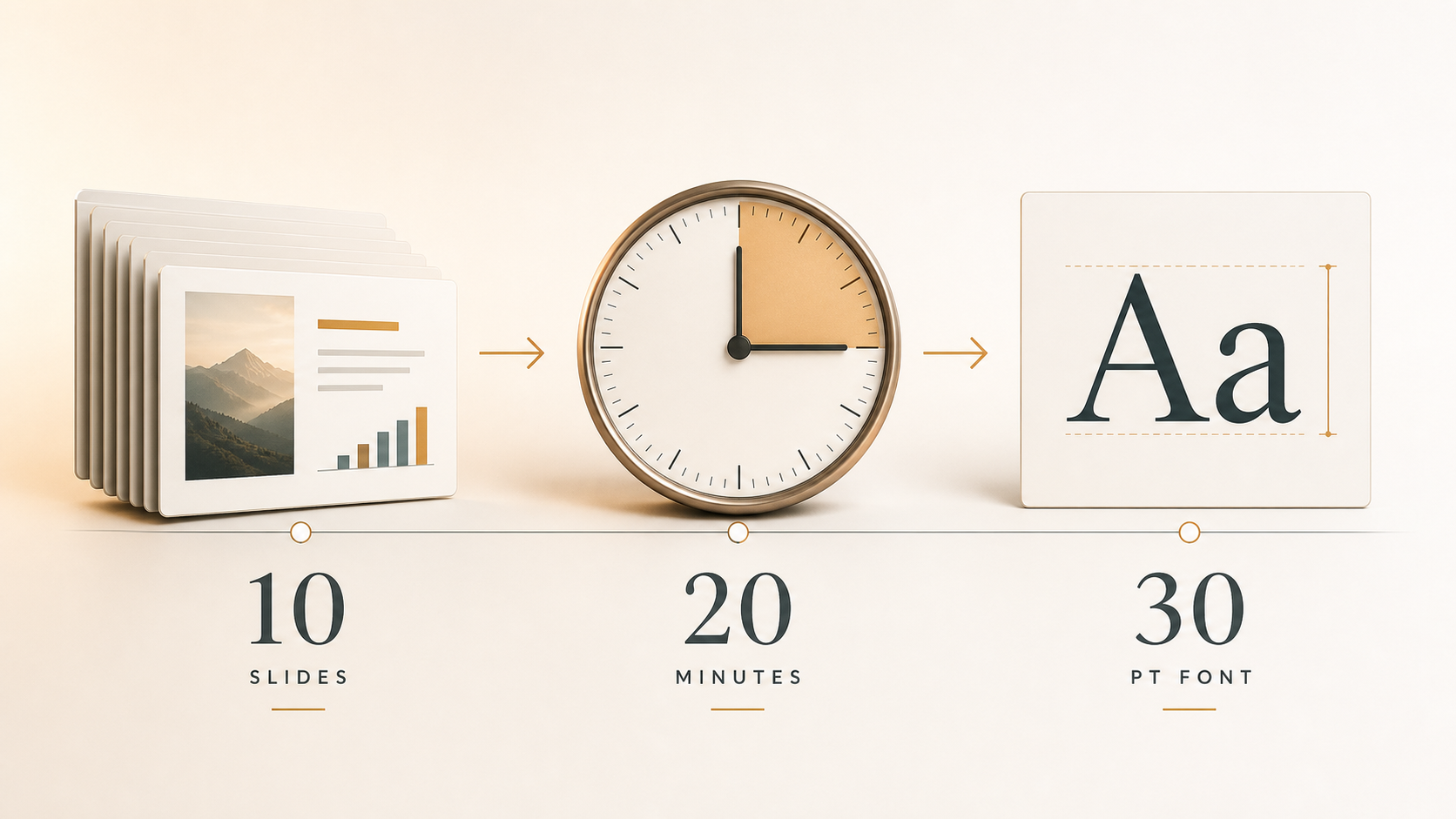
For a Guy Kawasaki pitch deck, the rule remains a powerful default. For broader professional presentations, it is a reminder that clarity usually beats completeness in the room. If the audience understands the problem, believes the solution, trusts the evidence, and knows the next step, the presentation has done its job.
Frequently Asked Questions (FAQ)
Q: What does the 10/20/30 rule mean? A: The 10/20/30 rule means a presentation should ideally use 10 slides, be delivered in 20 minutes, and use at least 30-point font. It is most often associated with Guy Kawasaki and pitch deck presentations.
Q: Does the 10/20/30 rule only apply to pitch decks? A: No. It is most famous for pitch decks, but the principle applies to many business presentations. Executive briefings, sales decks, and strategy updates can all benefit from fewer slides, tighter pacing, and clearer text.
Q: Is 30-point font always necessary? A: Not always, but it is a useful constraint. The purpose is to prevent cramming and make slides easier to read. If you need smaller text, consider whether the content belongs in an appendix, handout, or separate detail slide.
Q: How can AI help create a concise presentation? A: AI can help organize the story, identify redundant content, improve slide hierarchy, and turn raw ideas into a clearer structure. Pi supports this process with Multi-Agent AI, business logic, professional structure, and premium visual quality for business-ready decks.


 Cross-Cultural Business Pitches: How to Communicate Globally with Confidence