Delivering Business Pitches in English: A Guide for Non-Native Speakers
Many capable professionals understand their market, product, financial model, and customer problem deeply, yet feel less confident when they have to present those ideas in English. A non-native speaker pitch can feel risky because every word seems to carry extra pressure: pronunciation, grammar, pacing, questions, and slide wording all compete for attention.
The good news is that persuasive business pitching does not require perfect English. It requires a clear business story, simple language, well-structured slides, and enough preparation to reduce uncertainty. In many high-stakes meetings, audiences are not judging whether you sound like a native speaker. They are judging whether your opportunity is credible, your logic is easy to follow, and your recommendation deserves action.
Your English Does Not Need to Be Perfect to Be Persuasive
In business presentations, clarity usually matters more than fluency https://hbr.org/2013/06/how-to-give-a-killer-presentation . Investors, executives, clients, and partners want to understand the decision in front of them. If your message is structured, your evidence is relevant, and your next step is clear, small language imperfections rarely damage credibility.
Strong English presentation tips for non-native speakers often start with restraint. Short sentences are easier to deliver and easier for the audience to process. Familiar words are safer than complex vocabulary. Direct phrasing sounds more confident than long, academic explanations.
The goal is not to hide your accent or remove every trace of your first language. The goal is to make your business case easy to understand. A calm speaker using simple English can sound more executive than a nervous speaker using complicated phrasing.
A persuasive pitch usually depends on:
- A clear problem and audience pain
- A solution that is easy to explain
- Evidence that supports your claim
- Slides that reduce, rather than increase, language pressure
- A confident close with a specific ask
Start With a Clear Business Story Before You Polish the Language
Before you edit sentences, clarify the pitch logic. Many non-native speakers begin by rewriting wording, but language improvement is difficult when the argument itself is not yet stable. If the structure is unclear, polished English will not solve the problem.
Start with six questions. What problem are you solving? Who feels that problem most urgently? Why is your solution different or timely? What proof shows that it works? What is the business value? What do you want the audience to do next?
Once those answers are clear, your English becomes easier to simplify. You can choose repeated terms, prepare transitions, and remove unnecessary explanations. This is especially important for pitch decks, sales decks, executive updates, and client proposals, where audiences expect the storyline to move quickly.
A useful rule is: fix the logic first, then the language, then the delivery. If you reverse the order, you may spend hours practicing a script that still does not make the business case clearly.
Make Your Slides Easier to Say Out Loud
Business English slides should support your spoken delivery, not compete with it. When slides are full of long sentences, the presenter has to read, translate mentally, and explain at the same time. That increases stress and makes the audience work harder.
Write slide headlines as messages, not labels. Instead of “Market Overview,” use “Enterprise demand is shifting toward faster automation.” Instead of “Financials,” use “Recurring revenue is expanding as implementation costs decline.” A message headline gives you a ready-made speaking point.
Keep one core idea per slide. Use consistent terminology for important concepts, especially product names, customer segments, metrics, and pricing. If one slide says “mid-market clients” and another says “medium companies,” the audience may wonder whether you mean the same thing.
Visuals can also reduce language barriers. https://hbr.org/2016/06/visualizations-that-really-work Charts, comparison tables, timelines, and simple diagrams help audiences understand key numbers without requiring long verbal explanation. For non-native speakers, good slide design is not decoration; it is communication support.
| Presentation Need | Common Challenge for Non-Native Speakers | Stronger Business Pitch Approach |
|---|---|---|
| Opening | Too much background before the point | Start with the business problem |
| Slides | Full sentences that are hard to deliver | Use short message headlines |
| Data | Long explanation of numbers | Show one clear visual insight |
| Q&A | Anxiety when wording is unexpected | Prepare structured answer patterns |
| Closing | Polite but vague ending | State the specific next step |
Use Simple English That Sounds Executive, Not Basic
Simple English does not mean weak English. In business settings, concise language often sounds more senior because it respects the audience’s time. Executive communication is usually direct, structured, and outcome-focused.
Use strong verbs: reduce, increase, replace, accelerate, protect, expand, simplify. These words are easier to say and more powerful than long phrases. For example, “This feature reduces onboarding time” is stronger than “This functionality has the potential to make the onboarding process more efficient.”
Avoid idioms unless you are completely comfortable with them. Phrases like “move the needle,” “boil the ocean,” or “low-hanging fruit” may sound natural in some business cultures, but they can also create confusion. Plain English is safer and often more global.
Transitions also help. Use phrases such as “The key point is,” “This matters because,” “Let me show the evidence,” and “Based on this, our recommendation is.” These phrases guide the audience and give you time to move between ideas without searching for words.
Prepare the Phrases You Will Need Most
You should not memorize your full presentation word for word. A fully memorized script can become fragile if you forget one sentence or receive an unexpected question. Instead, prepare phrase patterns for moments that happen in almost every pitch.
For the opening, you might say, “Today, I will focus on three points: the problem, our solution, and the business impact.” To move between sections, use, “Now that we have seen the market need, let’s look at how the solution works.”
When emphasizing numbers, say, “The important number here is…” or “This trend shows that…” When acknowledging risk, say, “There are two risks we are watching closely.” When inviting questions, say, “I’m happy to go deeper on the assumptions behind this estimate.” For the close, use, “The decision we are asking for today is…”
These prepared phrases reduce pressure because they give you reliable language for key moments.
Practice for Questions, Not Just the Main Script
Q&A is often the hardest part of overcoming language barriers. The main pitch can be rehearsed, but questions are less predictable. This is where structure helps more than speed.
Prepare likely objections in advance. What will the audience challenge: pricing, adoption, competition, timing, ROI, implementation, or risk? Write short answer outlines, not long paragraphs. A strong answer can follow a simple pattern: acknowledge the question, give the short answer, support it with one reason or data point, then check whether the audience wants more detail.
If you do not understand a question, it is professional to ask for clarification. You can say, “Could you clarify whether you are asking about customer adoption or implementation cost?” This is better than guessing.
If you forget a word, do not stop. Explain around it using simpler words. Business audiences care more about the answer than the perfect term.
How Pi Helps Non-Native Speakers Build Stronger English Pitch Decks
Pi, short for Presentation Intelligence, is an AI presentation maker for professional business presentations. It is not a language-learning app, and it does not replace practice. Its value is in helping professionals turn complex ideas into clearer, more structured, business-ready decks in English.
1. Business Logic Comes Before Slide Styling
Pi helps shape the flow of a pitch around business logic: problem, solution, proof, value, and next step. For non-native speakers, this structure matters because a strong storyline reduces the amount of language improvisation required during delivery.
2. Slide Messaging Becomes Clearer
Pi can help transform dense ideas into sharper slide messages. Instead of forcing you to start from a blank PPT, it supports more focused headlines, cleaner section flow, and business English slides that are easier to present aloud.
3. Premium Design Supports Credibility
A polished deck helps the audience focus on the message instead of noticing formatting issues. Pi supports premium visual quality for pitch decks, sales decks, consulting reports, and executive presentations, making the final output feel prepared for high-stakes business settings.
4. Global Team Workflows Become Easier
For multilingual or global teams, Pi can support a more consistent presentation workflow. Teams can align around structure, terminology, and visual standards, which is especially useful when several contributors are preparing an English deck together.
A Practical Checklist Before You Present in English
Before the meeting, review your pitch from the audience’s perspective. Can they understand the business problem in the first two minutes? Does each slide have one message? Are your most important terms consistent across the deck?
Practice the first minute until it feels natural, because a confident start reduces anxiety. Rehearse the pronunciation of company names, product names, financial terms, and key metrics. Time your presentation without rushing. Prepare answers for the five questions you most expect.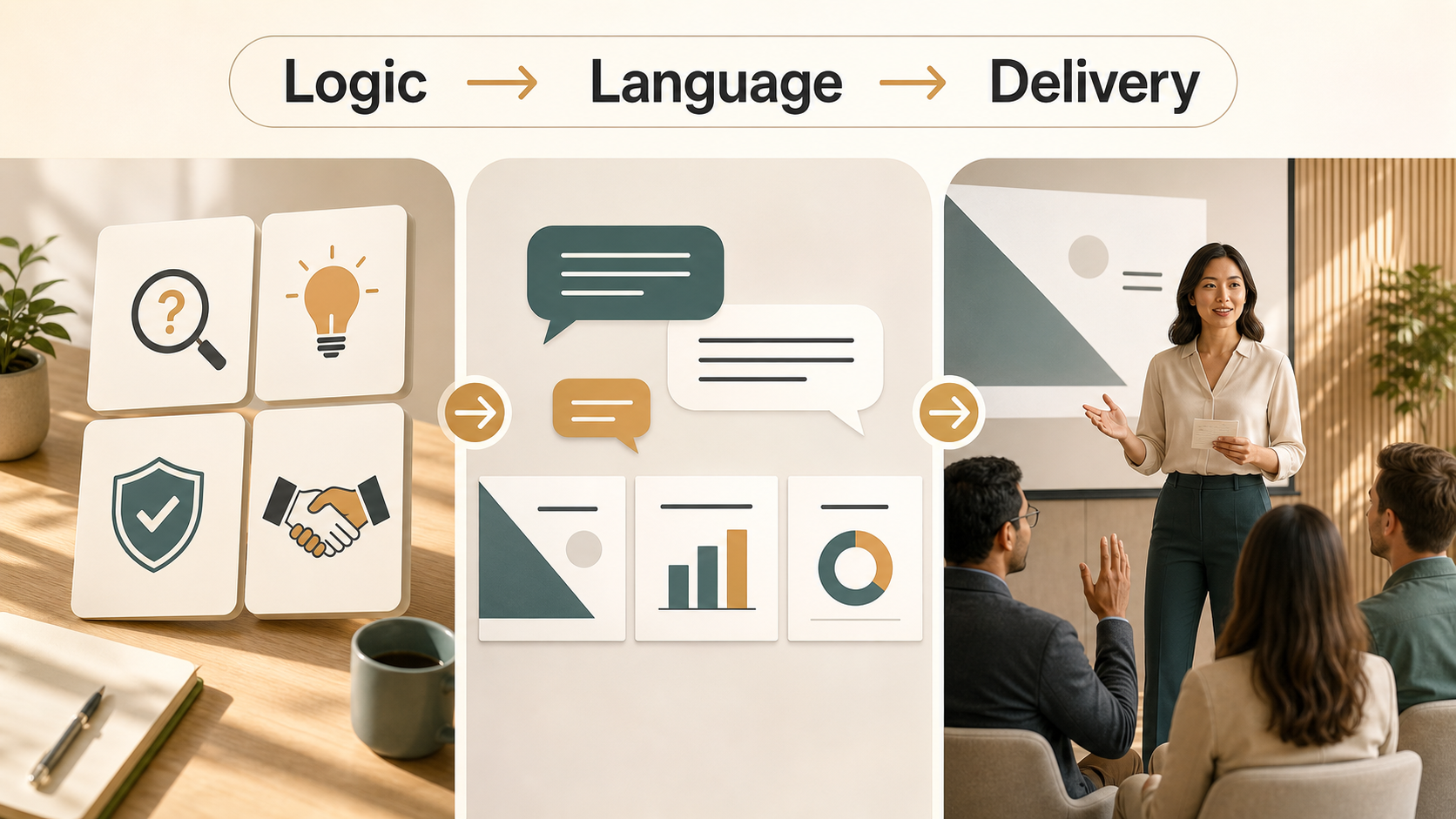
Finally, remind yourself that confidence does not mean perfect English. It means being prepared, clear, and ready to guide the audience through your business case.
Frequently Asked Questions (FAQ)
Q: Does my accent matter in an English business pitch? A: An accent does not reduce credibility by itself. What matters more is clarity, pacing, structure, and whether the audience can follow your business logic.
Q: How can I make business English slides easier to present? A: Use short message headlines, one idea per slide, consistent terms, and visuals for key numbers. Avoid long paragraphs that force you to read aloud.
Q: What should I do if I forget a word during the pitch? A: Keep going and explain the idea with simpler words. You can also pause briefly and rephrase. A smooth recovery is usually more important than the exact word.
Q: Can AI tools help with a non-native speaker pitch? A: Yes, AI tools can help structure the deck, refine slide wording, and improve clarity. Pi is useful for creating professional English pitch decks with stronger business logic and polished visual design.


 Cross-Cultural Business Pitches: How to Communicate Globally with Confidence