Presenting to C-Level Executives: Structuring Your Communication Logic
Executives do not reward more information. They reward clearer thinking.
When you present to executives, the challenge is rarely whether you know the material. It is whether you can organize the material around what senior leaders need to decide. A strong C-level presentation does not simply explain what happened, what you analyzed, or how much work went into the project. It clarifies the business point, frames the trade-offs, and makes the next action easier to approve.
That is why executive communication is a logic problem before it is a slide design problem. The best presenters lead with the answer, support it with disciplined evidence, and show exactly what decision or commitment is needed.
Why Executive Presentations Feel Different
A C-level presentation feels different because the audience is operating at a different altitude. Executives are responsible for broad priorities: growth, risk, profitability, customer impact, operational efficiency, investor confidence, and organizational alignment. They are not only listening for facts. They are listening for business consequence.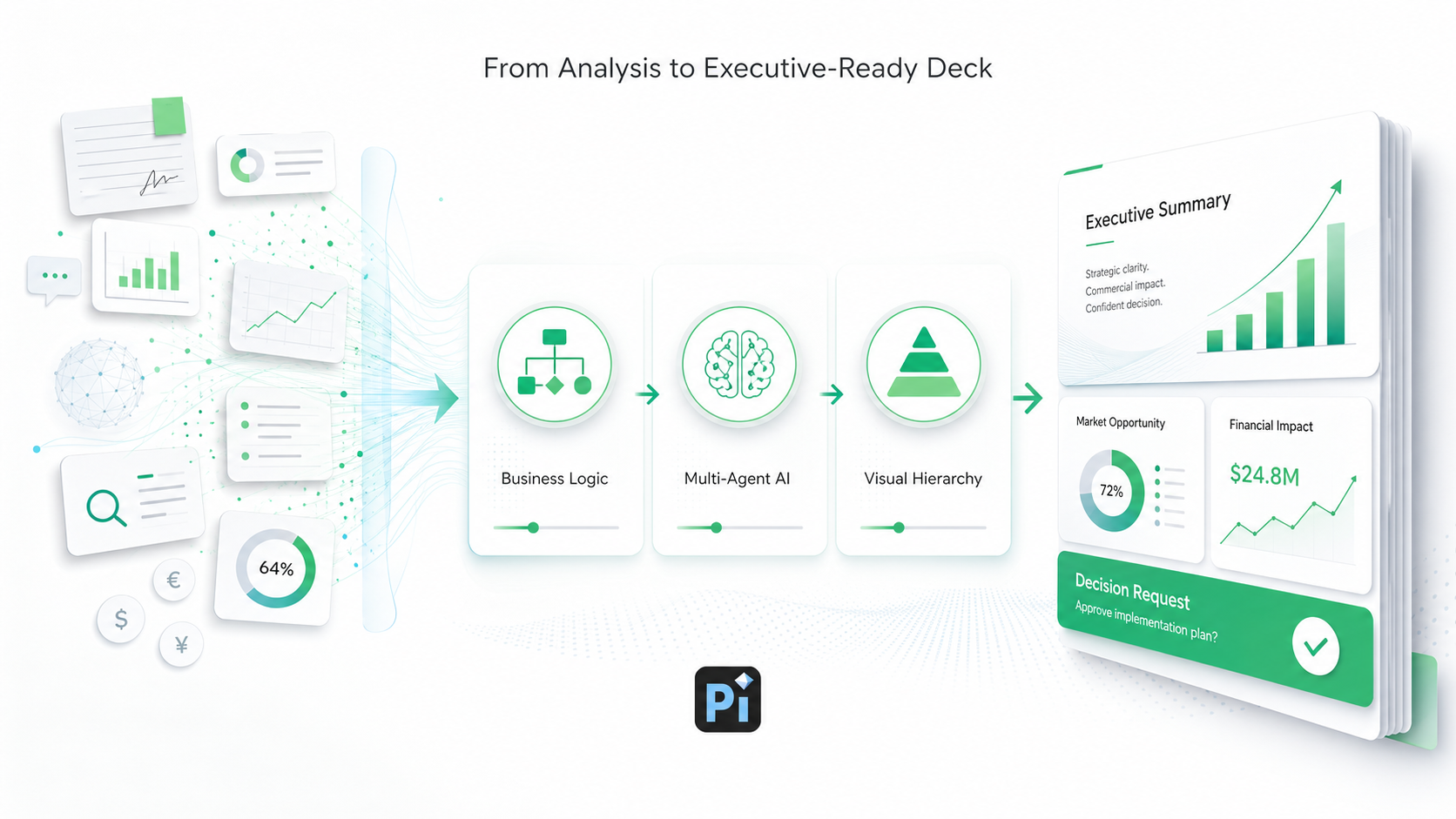
This does not mean executives dislike detail. It means they need the right level of detail at the right moment. If the first ten minutes are spent on background, methodology, and internal process, the executive audience may begin asking questions before the presenter reaches the point. Those interruptions are not always a sign of impatience. Often, they are an attempt to locate the decision.
To present to executives effectively, your communication must match how they process information: quickly, selectively, and through the lens of accountability.
The Biggest Mistake: Building the Presentation Around Your Work Instead of Their Decision
Many professionals structure presentations in the order they completed the work. They begin with context, move through research, show analysis, explain options, then finally reveal the recommendation. This feels logical to the presenter because it mirrors the project journey.
But executives are not joining the journey from the beginning. They are entering at the decision point.
The communication gap usually appears when the presenter focuses on:
- what the team did, rather than what leaders need to decide;
- how much analysis was completed, rather than what the analysis proves;
- all available data, rather than the data that changes the decision;
- chronological process, rather than business implication.
This is why executive summary skills matter. An executive summary is not a shorter version of the full presentation. It is the controlling logic of the presentation. It tells the audience what matters, why it matters, and what should happen next.
Use Bottom-Line-Up-Front Communication
Bottom-line-up-front communication, often called BLUF, means starting with the answer before explaining the path. In a C-level presentation, https://hbr.org/2015/03/how-to-brief-a-senior-executive the opening should quickly state the recommendation, conclusion, or key implication.
Instead of beginning with, “We analyzed three market segments over the past quarter,” start with, “We recommend prioritizing Segment B because it offers the fastest path to profitable expansion with manageable execution risk.”
The second version gives executives a decision frame. They now know what you believe, why the topic matters, and what evidence they should evaluate. Supporting details still matter, but they are no longer floating without direction.
BLUF does not mean being simplistic. It means giving the audience a mental map before asking them to absorb detail. That is the foundation of strong business communication logic.
Structure Your Logic Around Four Executive Questions
A strong C-level presentation should answer four questions in order.
First: what is the point? This is your main message. It may be a recommendation, warning, opportunity, update, or decision request. The point should be specific enough that an executive can repeat it after one slide.
Second: why does it matter? This connects your message to business impact. Revenue, margin, risk, speed, customer retention, competitive position, cost, and execution capacity are typical executive-level concerns. If the point has no clear business consequence, it may not belong in the main storyline.
Third: what supports it? Evidence should be selective, not exhaustive. Use the strongest proof: trend data, customer insight, financial model, operational constraint, competitive signal, or pilot result. The goal is not to show every analysis. The goal is to prove that the recommendation is credible.
Fourth: what decision or action is needed? Every executive presentation should make the requested next step clear. Are you asking for budget, alignment, approval, prioritization, escalation, or permission to proceed? If the ask is vague, the presentation may create discussion without movement.
What to Include and What to Cut
The main presentation should include only the details that help executives understand the decision, evaluate the trade-offs, and act with confidence. Everything else should move to an appendix, backup slide, or separate working document.
A useful test is to ask: “Would this detail change the decision?” If the answer is no, it may not need to appear in the main deck. If the answer is yes, it should be included clearly and early enough to influence the conversation.
| Presentation Element | Conventional Work-Based Flow | Executive-Ready Logic |
|---|---|---|
| Opening | Background and process | Recommendation or key implication |
| Evidence | All major analysis | Selective proof tied to decision |
| Detail level | Comprehensive | Relevant and staged |
| Slide headline | Topic label | Business insight |
| Ending | Summary of work completed | Decision request and next action |
This discipline is especially important in high-stakes meetings. Executives can ask for more detail when needed. Your job is to ensure the main path is not blocked by secondary information.
Turning Communication Logic Into Executive-Ready Slides
Once the logic is clear, the slides should make that logic visible. A strong executive slide is not just attractive. It has a clear role in the argument.
1. Business Logic Comes Before Slide Styling
Before choosing layouts or visuals, define the storyline. What is the executive audience supposed to understand after each slide? Each slide should advance the argument, not simply display information. The headline should state an insight, the body should provide selective proof, and the closing should point toward action.
This is where Pi, short for Presentation Intelligence, can support professional teams. As an AI presentation maker and AI PPT generator, Pi helps convert scattered analysis, recommendations, and supporting data into structured, business-ready presentations. For executive presentations, the value is not only faster slide creation. It is the ability to organize the deck around a sharper communication logic.
2. Multi-Agent AI Helps Refine the Storyline
Executive decks often require multiple forms of judgment: strategic framing, content prioritization, visual hierarchy, and business tone. Pi’s Multi-Agent AI is built for this deeper workflow, helping teams move beyond a generic first draft toward a more coherent executive narrative.
That matters for consulting reports, sales decks, strategic business reviews, market research decks, and board-style presentations, where the storyline must be both concise and defensible.
3. Premium Visual Quality Reinforces Credibility
Visual polish does not replace strategic thinking, but it does affect how quickly the audience trusts the material. Clean structure, strong hierarchy, consistent formatting, and business-grade aesthetics reduce cognitive load. https://www.nngroup.com/articles/minimize-cognitive-load/ Executives should not have to decode cluttered slides while also evaluating the recommendation.
Pi helps teams present complex business logic in a more polished format, so the deck feels prepared, controlled, and appropriate for senior-level discussion.
A Simple Executive Presentation Flow
A practical C-level presentation can follow a simple sequence.
Start with the context in one brief moment: what changed, what triggered the discussion, or why the topic matters now. Then state the recommendation or key conclusion. After that, quantify the business impact, such as revenue upside, cost reduction, risk exposure, speed advantage, or strategic relevance.
Next, show the evidence that supports the recommendation. Keep it selective. Then address risks and trade-offs directly, because executives will think about them whether or not you mention them. Finally, present the implementation path and decision request.
A simple flow might be: context, recommendation, business impact, evidence, risks, implementation path, decision needed. This structure works because it respects executive attention while still giving leaders enough substance to challenge, refine, or approve the idea.
Final Verdict: Clarity Is the Executive Skill
Presenting to executives is less about performance and more about disciplined thinking. Confidence helps, but clarity carries the meeting.
The best executive presenters reduce cognitive load. They do not make senior leaders search for the point, infer the business impact, or guess the requested action. They lead with the answer, explain why it matters, support it with relevant evidence, and make the decision path visible.
If you want to present to executives more effectively, improve the logic before improving the slides. A polished deck can strengthen a message, but only if the message is already structured around executive priorities: decision, impact, risk, and action.
Frequently Asked Questions (FAQ)
Q: How long should a C-level presentation be? A: It should be as short as the decision allows. Many executive presentations work best in 10 to 20 minutes, with backup slides available for deeper discussion. The goal is not to fill the time. The goal is to reach a clear decision or alignment point.
Q: Should I include detailed data in a C-level presentation? A: Yes, but only when the data directly supports the decision. Put the most important evidence in the main deck and move secondary analysis to the appendix. Executives care about detail, but they need it organized around relevance and timing.
Q: How should I handle interruptions from executives? A: Treat interruptions as signals about what the audience needs. Answer directly, then connect the response back to the main logic. If the question requires deep detail, give the short answer first and offer to go into the appendix if needed.
Q: How can I make my executive summary stronger? A: Start with the recommendation or main implication, connect it to business impact, summarize the proof, and state the decision needed. A strong executive summary should make the rest of the presentation easier to follow, not simply preview the slide agenda.


 Cross-Cultural Business Pitches: How to Communicate Globally with Confidence