Generating Cohesive Visuals: Why It's Time to Ditch Cheesy Stock Photos
A strong presentation can lose credibility the moment the visuals feel generic. You may have a sharp business model, a persuasive market insight, or a well-structured proposal, but if the deck is filled with staged handshakes, smiling office teams, and vaguely futuristic city skylines, the message can start to feel less specific than it really is.
That is the problem with many stock-photo-driven decks. The images are not always low quality. In fact, many are technically polished. The issue is that they often look detached from the strategy. They suggest “business” in a broad sense, but they rarely express your business, your audience, your tone, or your point of view.
For professional teams building pitch decks, sales decks, executive presentations, consulting reports, or brand proposals, visuals are no longer just decoration. They are part of the argument. That is why AI generated slide backgrounds, cohesive presentation images, and custom pitch deck art are becoming a serious alternative to stock photos.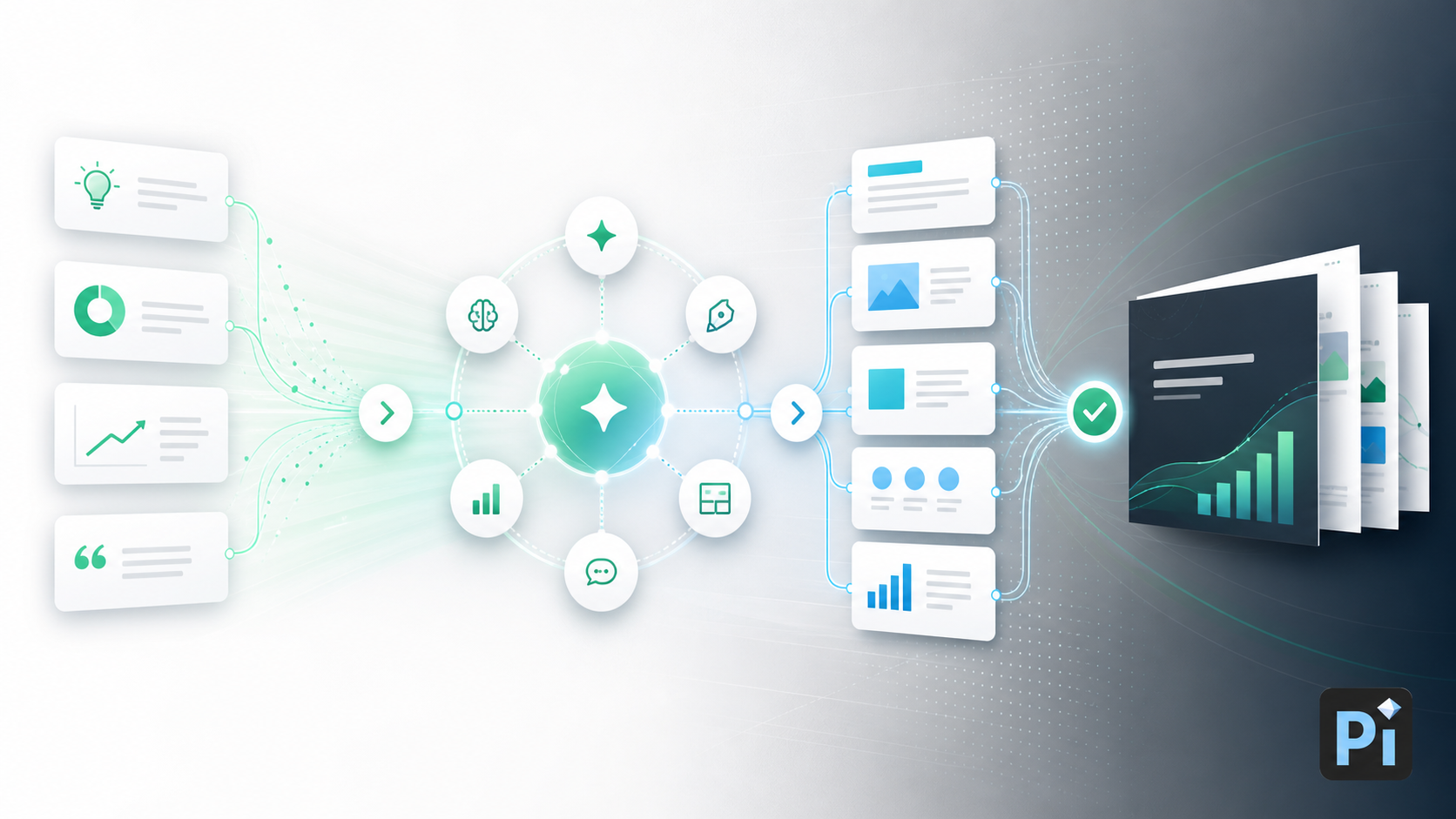
Why Stock Photos Often Weaken Business Presentations
Stock photos work best when the visual need is simple: a generic office scene, a product-adjacent lifestyle image, or a neutral background. The challenge begins when a deck needs to feel custom, premium, and strategically aligned.
Business stock imagery tends to repeat the same visual clichés. Teams pointing at glass boards. People shaking hands across conference tables. A lone professional looking at a skyline. These images are familiar because they are useful shorthand, but overuse makes them feel less credible in high-stakes contexts.
Stock photos also introduce inconsistency. One slide may have warm natural light, another may use cool studio lighting, and another may show a completely different environment. The people, camera angles, colors, and emotional tones rarely feel like they belong to the same story. Even when each image is attractive on its own, the deck can feel assembled rather than designed.
The most common boundaries appear when stock photos create:
- Overused business clichés that make a distinctive idea feel generic
- Mismatched lighting, color temperature, and composition across slides
- People, settings, or props that do not reflect the audience or market
- Visuals that fill space but do not support the slide’s message
- A lower perceived production value than the underlying strategy deserves
Stock photos are not always unusable. They become limiting when the deck needs to look like it was built around a specific business argument.
What Cohesive Presentation Visuals Actually Mean
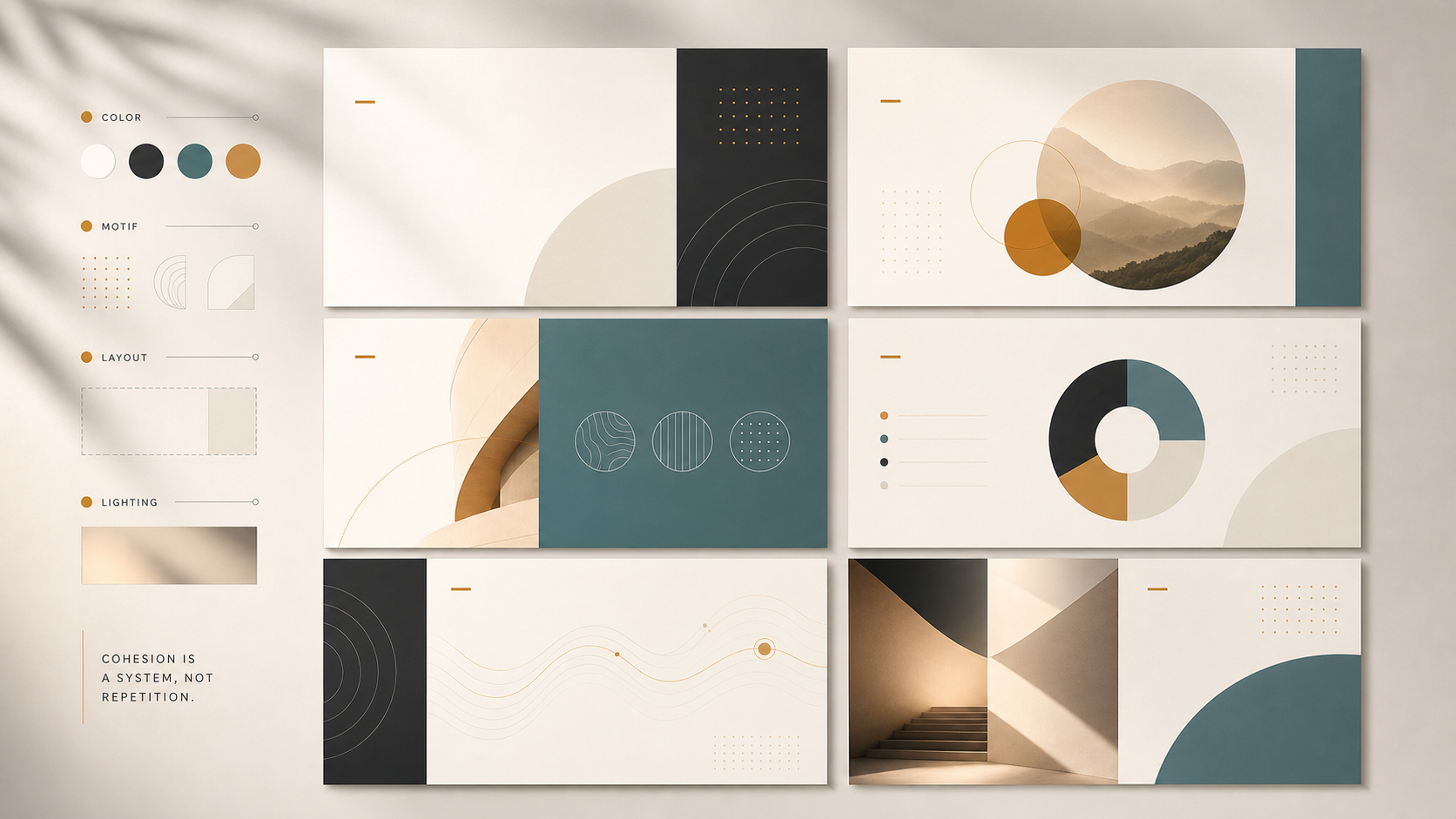
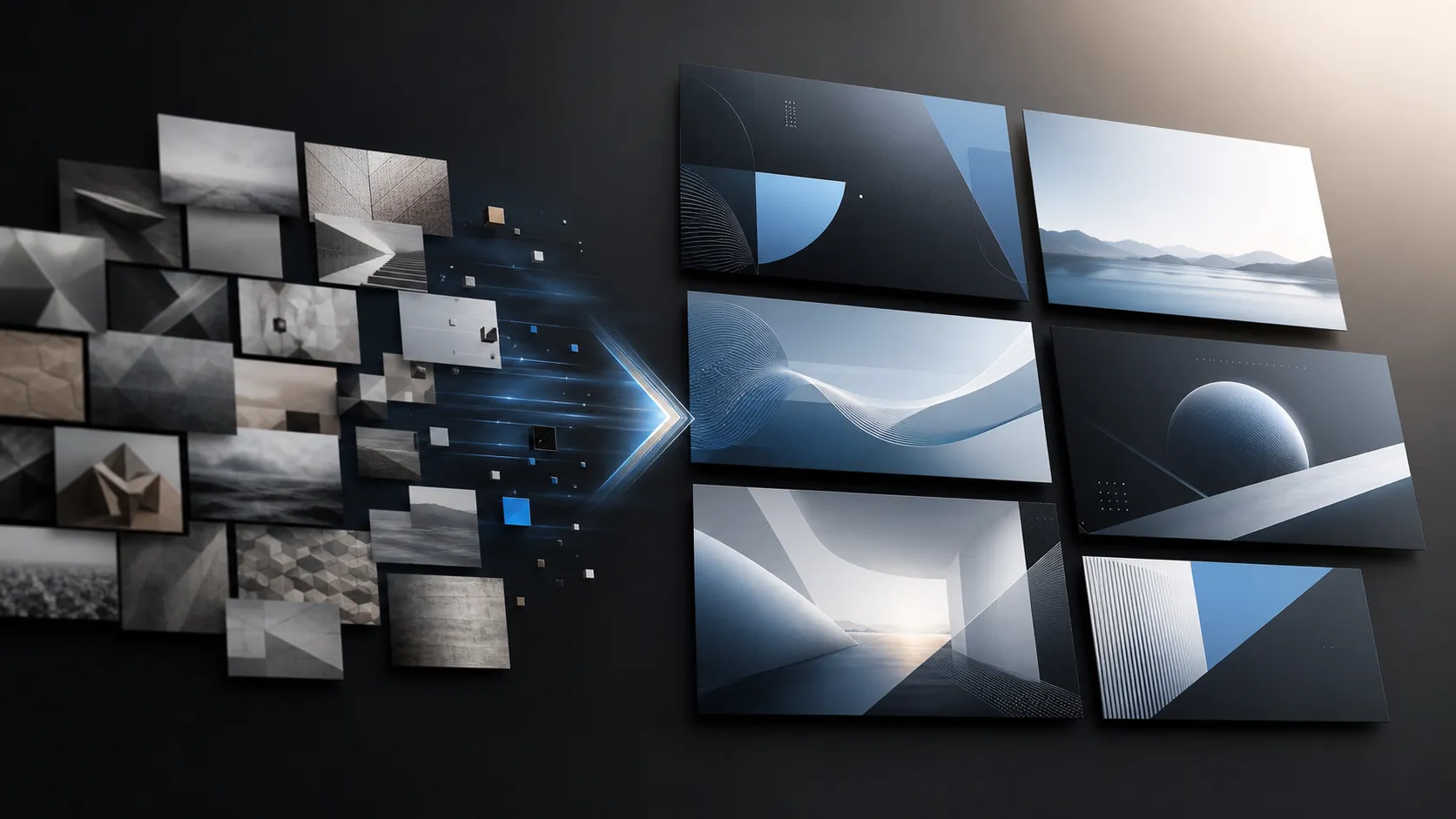
Cohesive presentation images do not mean every slide should look identical. A visually cohesive deck can include charts, abstract backgrounds, product visuals, diagrams, and atmospheric imagery. The key is that all of those elements feel guided by the same visual direction.
Cohesion is a system. It includes the color palette, contrast level, mood, texture, composition, abstraction level, icon style, image treatment, and relationship between visuals and text. A deck about cybersecurity may use dark interfaces, controlled gradients, and precise geometric forms. A healthcare innovation deck may use softer light, human-centered photography, and calm blue or green accents. A climate technology pitch may combine data visuals with landscapes, infrastructure, and clean energy motifs.
The point is not to make slides look repetitive. The point is to make them feel intentional. Every visual should help the audience understand the argument faster, remember the message more clearly, or trust the presenter more deeply.
Why AI Generated Slide Backgrounds Are Changing the Workflow
AI generated slide backgrounds change the presentation workflow because they make it possible to create visuals around the deck’s narrative instead of forcing the narrative to fit available images.
Rather than searching through hundreds of stock photos for something “close enough,” teams can create custom visual atmospheres that match a specific market, product category, audience, or strategic theme. A financial transformation deck can use consistent abstract systems that suggest precision and momentum. A SaaS pitch deck can use clean, layered technology environments without relying on fake dashboards or generic office scenes. A brand proposal can develop a unique visual world that feels more ownable than common stock photography.
This is especially useful for business concepts that are difficult to photograph: operational efficiency, platform scalability, customer intelligence, risk reduction, market expansion, or strategic alignment. AI-driven visuals can translate those abstract ideas into slide backgrounds, conceptual scenes, and supporting imagery that feel consistent from slide to slide.
The benefit is not just novelty. It is control. AI can help teams define a visual language, repeat motifs, adapt scenes to different slide types, and build custom pitch deck art that looks like it belongs to one coherent presentation.
The New Risk: AI Images Can Still Look Generic
AI visuals are not automatically better than stock photos. If a team uses vague prompts, accepts the first output, or prioritizes visual spectacle over clarity, AI can simply create a new kind of cliché.
Common risks include:
- Inconsistent style across slides when prompts change too much
- Visual noise that makes text harder to read
- Unrealistic details that distract from the business message
- Overly futuristic images that feel disconnected from the company
- Backgrounds that compete with the slide’s core insight
The strongest AI-generated presentation visuals come from discipline, not randomness. They require clear direction, consistent constraints, and a strong understanding of what each slide needs to communicate.
How to Build a Cohesive Visual Direction for a Deck
Start by defining the tone of the presentation. Is the deck meant to feel bold, analytical, calm, premium, disruptive, technical, human, or visionary? Tone should come before image selection because it determines the right visual language.
Next, choose a consistent visual approach. This might be cinematic photography, refined 3D abstraction, editorial-style business imagery, minimal vector illustration, or atmospheric gradient backgrounds. The style should match both the audience and the business context. Investor decks often need clarity and confidence. Sales decks need relevance and persuasion. Executive presentations need control and efficiency.
Then create constraints. A useful direction might define a limited color palette, preferred lighting, camera perspective, texture level, and amount of detail. Constraints help AI generated slide backgrounds feel related rather than random.
Repeat visual motifs across the deck. This could mean recurring shapes, horizon lines, grid structures, product-inspired forms, data patterns, or environmental cues. Motifs create continuity without requiring every slide to use the same image.
Finally, design for readability. https://www.nngroup.com/articles/legibility-readability-comprehension/ A beautiful background fails if the headline is hard to read or the data becomes secondary. Professional decks need controlled contrast, clear focal areas, and space for text. Every image should serve the slide purpose, not fight it.
Where Pi Fits: From Custom Visuals to Business-Ready Presentations
Pi, short for Presentation Intelligence, is built for teams that need more than isolated visual assets. Custom images can improve a deck, but professional presentations also need business logic, narrative structure, message hierarchy, and premium visual quality. That is where an AI presentation maker needs to operate beyond simple decoration.
1. Business Logic Comes Before Slide Styling
Pi helps teams shape the argument before polishing the visuals. In a pitch deck, that means clarifying the market problem, solution, traction, business model, and investor narrative. In a consulting report, it means organizing findings, recommendations, and evidence into a persuasive flow.
This matters because cohesive presentation images are only effective when they reinforce the logic of the deck. A beautiful visual system cannot rescue a weak storyline. Pi is designed to connect structure and aesthetics so that visual decisions support the business message.
2. Multi-Agent AI Supports Deeper Presentation Workflows
Pi uses Multi-Agent AI to support different layers of presentation creation, from structure and content logic to design direction and refinement. Instead of treating a deck as a single prompt-to-slide output, Pi helps professional teams work through the complexity of a real business presentation.
That is especially valuable for high-stakes workflows such as investor pitches, enterprise sales decks, product launch narratives, market research decks, and executive briefings. In these contexts, the deck must feel both visually premium and strategically sound.
3. Premium Visual Quality Meets Professional Use Cases
Pi is not positioned as a standalone image generator. Its value is in helping teams build complete, business-ready presentations where visuals, layouts, messaging, and flow work together. When custom visual assets are needed, they should fit the deck’s tone, not sit on top of it as decoration.
For teams moving away from generic stock imagery, Pi provides a workflow for building presentations that feel custom, coherent, and credible.
Stock Photos vs. AI-Driven Presentation Visuals
| Visual Need | Stock Photos | AI-Driven Presentation Visuals |
|---|---|---|
| Cohesion across slides | Often inconsistent in lighting and style | Can follow a defined visual system |
| Customization | Limited to available assets | Built around the deck’s specific message |
| Brand fit | May require heavy editing | Can match tone, palette, and audience |
| Business context | Often generic | Can express abstract business concepts |
| Slide-to-slide consistency | Difficult to maintain | Easier with repeated constraints and motifs |
A Practical Verdict for Professional Teams
Stock photos are not obsolete. They can still work when the need is simple, neutral, or secondary. But they are no longer the default best option for serious business decks.
When a presentation must feel premium, specific, and strategically aligned, random image selection is not enough. Professional teams need a visual system: a consistent direction that supports the narrative, strengthens credibility, and makes the message easier to understand.
AI generated slide backgrounds and custom pitch deck art offer a stronger path when used with discipline. The goal is not to replace every stock photo with an AI image. The goal is to design visuals around the argument, the audience, and the business moment.
For teams that need complete presentations rather than disconnected assets, Pi helps bring that system together through business-ready structure, Multi-Agent AI, and premium visual quality.
Frequently Asked Questions (FAQ)
Q: Are AI generated slide backgrounds https://www.ibm.com/think/topics/ai-agents better than stock photos? A: They can be better when a deck needs custom, cohesive, and message-specific visuals. Stock photos are useful for simple needs, but AI generated slide backgrounds offer more control over mood, style, and slide-to-slide consistency.
Q: How do I make presentation images look cohesive? A: Define the deck’s tone, choose a consistent visual language, limit the color palette, repeat visual motifs, and ensure every image supports the slide’s purpose. Cohesion comes from a system, not from making every image look identical.
Q: Can AI visuals be used in pitch decks? A: Yes. AI visuals can be effective in pitch decks when they reinforce the business narrative, clarify abstract ideas, and create a premium impression. They should be reviewed carefully for accuracy, readability, and brand fit.
Q: What makes Pi useful for professional presentation visuals? A: Pi connects visual quality with presentation logic. It helps teams build business-ready decks with strong structure, premium aesthetics, and Multi-Agent AI support, so visuals reinforce the message instead of acting as decoration.
 he Rise of Dark Mode: When and How to Use Dark Backgrounds in Presentations
 Generating Cohesive Visuals: Why It's Time to Ditch Cheesy Stock Photos