SaaS Competitor Analysis Pitch Deck: How to Benchmark Like a Pro
For SaaS founders, strategy teams, and marketers, the competitor analysis slide is often one of the most scrutinized parts of a pitch deck. Investors and executives are not only checking whether you know the other companies in the market. They are testing whether you understand customer pain, category dynamics, defensibility, pricing pressure, and your real path to win.
A strong SaaS competitor analysis PPT does more than display logos. It turns market research into a clear business argument: where the market is crowded, where customers remain underserved, and why your company is positioned to capture a valuable opportunity.
Why SaaS Competitor Analysis Slides Matter in a Pitch Deck
In a tech startup pitch deck, competitor analysis is rarely just a research section. It is a credibility test. If the slide feels shallow, biased, or incomplete, the audience may question the rest of the business case. If it feels structured and honest, it can strengthen the entire presentation.
For investors, competitor analysis helps answer several critical questions. Is the market large enough to support multiple winners? Does the company understand direct and indirect alternatives? Are customers switching because of real pain, or because the deck simply claims a better product? Is the team realistic about sales cycles, pricing, and market entry?
For executive audiences, the same section helps clarify strategic focus. It shows where the company should compete, where it should avoid overextending, and which competitive gaps are worth turning into product, GTM, or positioning priorities.
The Mistake Most SaaS Benchmarking Slides Make
Many SaaS benchmarking slides fail because they are designed to make the company look good rather than to explain the market clearly. The result is often a slide that looks confident but does not feel credible.
Common issues include:
- Logo grids that show many competitors but explain very little
- Feature tables where the company conveniently wins every row
- Positioning maps with vague axes such as “easy” and “powerful”
- Claims about superiority without evidence from customers, pricing, traction, or product depth
- Overly detailed matrices that are impossible to read in a live pitch
A professional benchmarking slide template should not pretend competitors are weak. Strong competitors can validate the market. The real goal is to show how your company competes differently, which customer segment you serve best, and why that focus matters now.
What a Professional SaaS Competitor Analysis Should Prove
A SaaS competitor analysis should prove four things. First, it should show market awareness. You know the main players, adjacent alternatives, legacy solutions, and manual workarounds customers use today.
Second, it should show differentiated positioning. The deck should make it easy to understand whether you compete on workflow depth, speed, automation, integrations, vertical specialization, pricing, service model, or enterprise readiness.
Third, it should show customer insight. The best competitor slides are built around buyer needs, not internal feature preferences. They explain why a segment is underserved and what trade-offs customers are currently forced to accept.
Fourth, it should show a credible path to win. That path may come from a wedge product, a focused ICP, a better GTM motion, stronger data advantage, or superior workflow fit. The slide should connect competitive research to business strategy.
A Practical SaaS Competitor Benchmarking Framework
Before building slides, define the dimensions that actually matter in your category. For SaaS, a useful framework usually includes market category, customer segment, product capability, pricing model, GTM motion, traction signals, positioning, and strategic gaps.
Market category clarifies whether competitors are direct replacements, adjacent platforms, point solutions, or manual alternatives. Customer segment identifies whether each competitor serves SMB, mid-market, enterprise, vertical-specific, or developer-led buyers. Product capability compares meaningful workflow depth instead of isolated features.
Pricing model matters because it affects adoption and sales motion. A usage-based API product competes differently from a seat-based SaaS platform. GTM motion also matters: product-led growth, founder-led sales, channel sales, and enterprise sales create different competitive advantages.
Traction signals can include customer logos, funding stage, hiring patterns, user reviews, public revenue indicators, ecosystem partnerships, or product velocity. These signals should be validated by the team, not assumed by AI. Positioning explains the promise each competitor makes to the market. Strategic gaps identify the underserved space your company can credibly own.
What to Include in a SaaS Competitor Analysis PPT
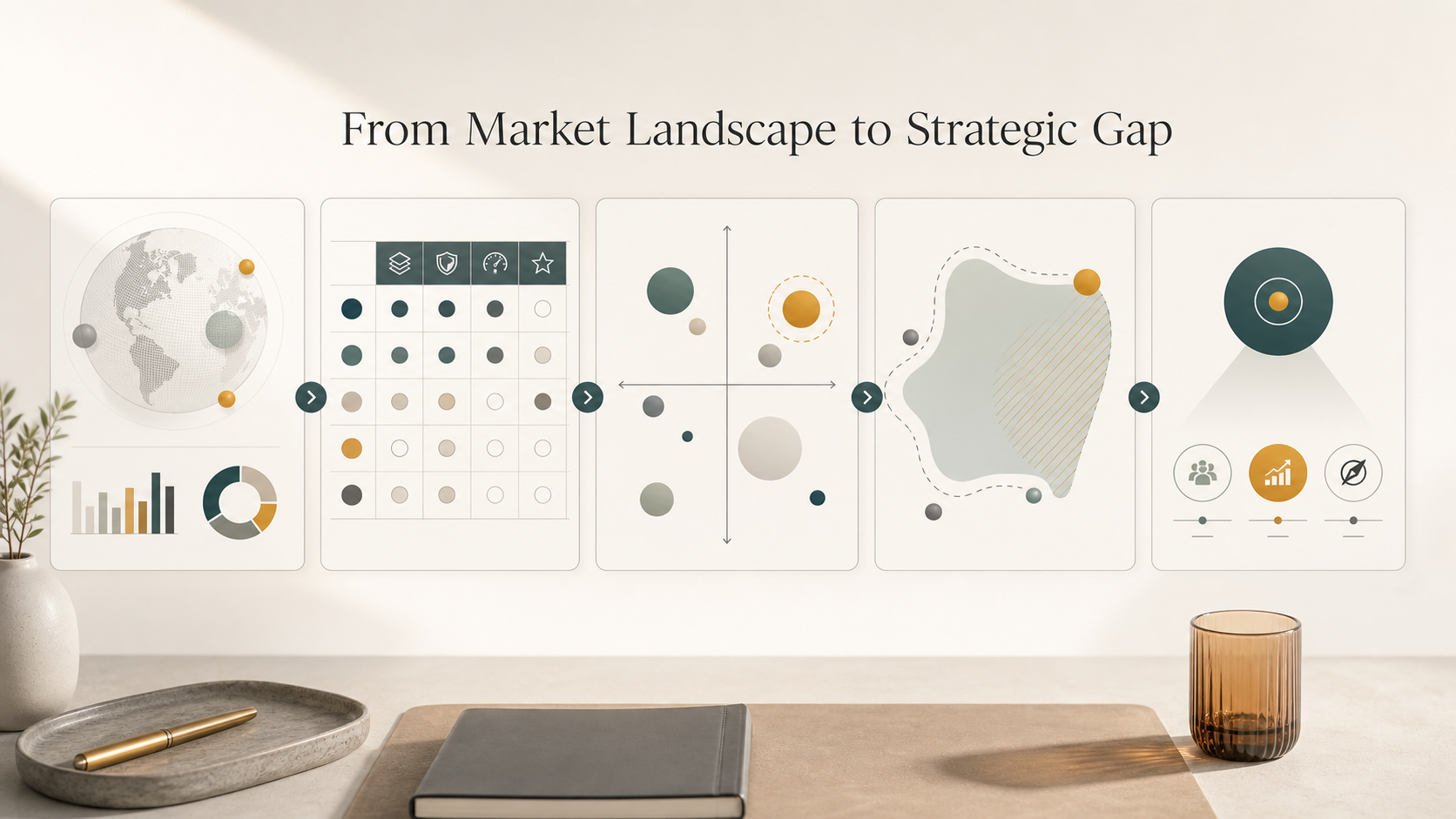
A complete SaaS competitor analysis PPT usually needs more than one slide, especially for investor or board-level presentations. A market landscape slide can classify the competitive field. A competitor matrix can compare business-critical dimensions. A positioning map can show where your company sits relative to customer needs. A feature and pricing benchmark can explain product and commercial trade-offs. An opportunity gap slide can reveal the underserved segment. A strategic takeaway slide can summarize why the company’s focus is defensible.
The key is sequence. Do not begin with a dense feature table. Start by framing the market, then narrow into the competitors that matter most, then explain the strategic gap. This makes the section feel like a business narrative rather than a collection of research notes.
SaaS Benchmarking Slide Template Structure
Use a slide structure that moves from landscape to insight. The audience should first understand the market shape, then the comparison logic, then the opportunity.
| Slide | Purpose | Data Needed | Audience Takeaway |
|---|---|---|---|
| Market Landscape | Categorize competitors and alternatives | Company list, categories, customer types | The team understands the full market |
| Competitor Matrix | Compare strategic dimensions | Capabilities, ICP, pricing, GTM | Differences are specific and credible |
| Positioning Map | Show relative market position | Clear axes tied to buyer needs | The company owns a distinct space |
| Feature and Pricing Benchmark | Explain product and commercial trade-offs | Key features, packaging, price signals | Buyers face visible trade-offs |
| Opportunity Gap | Identify underserved needs | Customer pain, competitor limits | There is room for a focused winner |
| Strategic Takeaway | Connect analysis to plan | Wedge, roadmap, GTM priorities | The company has a path to win |
This structure works well for a SaaS competitor analysis PPT because it avoids two extremes: too little detail to be useful, or too much detail to be persuasive.
How Pi Helps Turn SaaS Research Into an Investor-Ready Deck
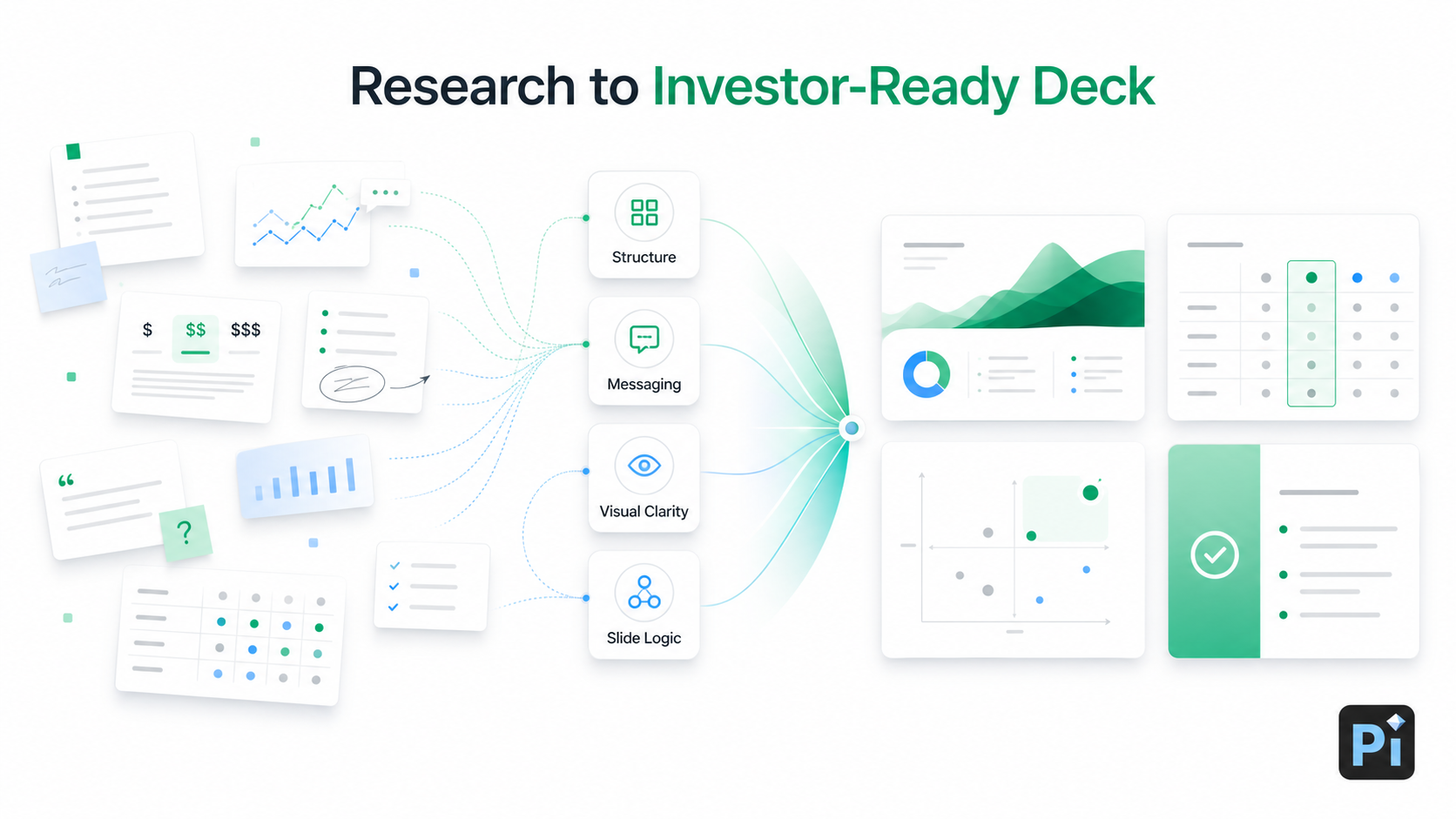
Pi, short for Presentation Intelligence, is an AI presentation maker built for professional business presentations. For SaaS competitor analysis, the challenge is not only creating slides. The harder task is turning messy research into a structured AI business presentation that investors, executives, and internal teams can quickly understand.
Pi helps teams move from raw notes, matrices, and positioning ideas into a business-ready deck structure. It does not replace the need for validated competitor data, but it can help organize that data into a clearer pitch deck workflow.
1. Business Logic Comes Before Slide Styling
A competitor analysis slide should begin with the market thesis, not with colors or icons. Pi helps teams organize the argument first: which competitors matter, what dimensions should be benchmarked, and what strategic gap the deck needs to prove.
This is especially useful when multiple stakeholders contribute research. Product teams may focus on features, sales teams may focus on objections, and founders may focus on positioning. Pi helps convert those inputs into a clearer narrative hierarchy.
2. Multi-Agent AI Supports Different Parts of the Workflow
Pi’s Multi-Agent AI approach is useful because a professional deck requires several kinds of thinking. One part of the workflow may focus on structure. Another may refine messaging. Another may help with slide logic, hierarchy, or visual clarity.
For a SaaS benchmarking slide template, this matters. The deck needs to compare competitors, but it also needs to explain why the comparison is meaningful. Pi supports that deeper workflow by helping teams shape research into slides that feel purposeful rather than generic.
3. Premium Visual Quality Makes Benchmarking Easier to Read
Competitor matrices, market maps, and pricing benchmarks can become crowded quickly. Premium visual quality is not decoration in this context; it improves comprehension. Clear hierarchy https://www.nngroup.com/articles/visual-hierarchy-ux-definition/ , spacing, contrast, and slide structure help the audience see the insight faster.
Pi is designed for business-grade aesthetics, making it useful for high-stakes workflows such as pitch decks, market research decks, consulting reports, and executive presentations. The result is not just a cleaner slide, but a more readable strategic argument.
Final Verdict: Benchmark the Market, Then Tell the Strategic Story
 A strong SaaS competitor analysis pitch deck is not about proving that every competitor is weak. It is about showing that your team understands the market with discipline and can identify a specific, valuable opportunity.
The best decks benchmark competitors through the lens of customer pain, product capability, pricing, GTM motion, positioning, and strategic gaps. They make the market easier to understand and the company’s strategy easier to believe.
If you already have competitor notes, customer insights, pricing research, or positioning hypotheses, Pi can help turn that raw material into a more structured, professional, and investor-ready AI business presentation.
Frequently Asked Questions (FAQ)
Q: What should be included in a SaaS competitor analysis PPT https://www.ibm.com/think/topics/multiagent-system ? A: Include a market landscape, competitor matrix, positioning map, feature and pricing benchmark, opportunity gap, and strategic takeaway. The section should explain not only who the competitors are, but how your company is positioned to win.
Q: How do you create a benchmarking slide template? A: Start by choosing comparison dimensions that matter to buyers, such as customer segment, product capability, pricing model, GTM motion, traction signals, and positioning. Then organize those dimensions into a clear matrix or map with one main takeaway.
Q: What is the best way to show competitors in a tech startup pitch deck? A: The best approach is to combine a market landscape with a focused positioning insight. Avoid claiming your company wins every category. Instead, show where competitors are strong, where customers remain underserved, and where your strategy creates an advantage.
Q: Can AI help create a business presentation for competitor analysis? A: Yes. AI can help structure research, organize slide flow, clarify messaging, and improve visual hierarchy. However, competitor data should still be verified by the team before it is used in an investor or executive presentation.
 he Rise of Dark Mode: When and How to Use Dark Backgrounds in Presentations
 Generating Cohesive Visuals: Why It's Time to Ditch Cheesy Stock Photos