HealthTech Product Launch Pitch Deck: Bridging Science and Commercial Value
Launching a medical device, digital health app, diagnostic tool, or healthcare platform is not the same as launching a typical SaaS product. The audience does not only ask whether the product is useful. They also ask whether it is credible, evidence-based, operationally feasible, and commercially viable.
That is why a strong HealthTech pitch deck must bridge two worlds. It needs enough scientific rigor to earn trust from clinicians, researchers, regulatory-minded stakeholders, and healthcare buyers. At the same time, it needs enough commercial clarity to help investors, partners, executives, and procurement teams understand the opportunity.
The best medical product launch presentation does not bury the audience in data or simplify the science until it loses meaning. It translates complex evidence into a decision-ready story.
Why HealthTech Pitch Decks Are Harder Than Standard Product Launch Decks
A standard product launch deck often focuses on user pain, product value, market opportunity, and growth strategy. Those elements still matter in HealthTech, but they are not enough. Healthcare audiences evaluate products through a more demanding lens because the stakes involve patient outcomes, clinical workflows, provider trust, and institutional risk.
A HealthTech product launch presentation may need to address:
- Clinical validity or scientific rationale
- Patient, provider, or operational impact
- Regulatory or validation status
- Reimbursement, procurement, or budget logic
- Data security and implementation considerations
- Evidence quality and limits
- Adoption barriers inside healthcare systems
This is where many healthcare startup slides become difficult to follow. The science team wants accuracy. The commercial team wants momentum. The investor wants market logic. The clinician wants proof. The buyer wants risk reduction. A strong deck must respect all of these concerns without becoming fragmented.
The Core Narrative: From Scientific Proof to Market Readiness
The central job of a HealthTech pitch deck is to move the audience from uncertainty to confidence. That does not mean overpromising results or making unsupported claims. It means sequencing the story so each section answers the next logical question.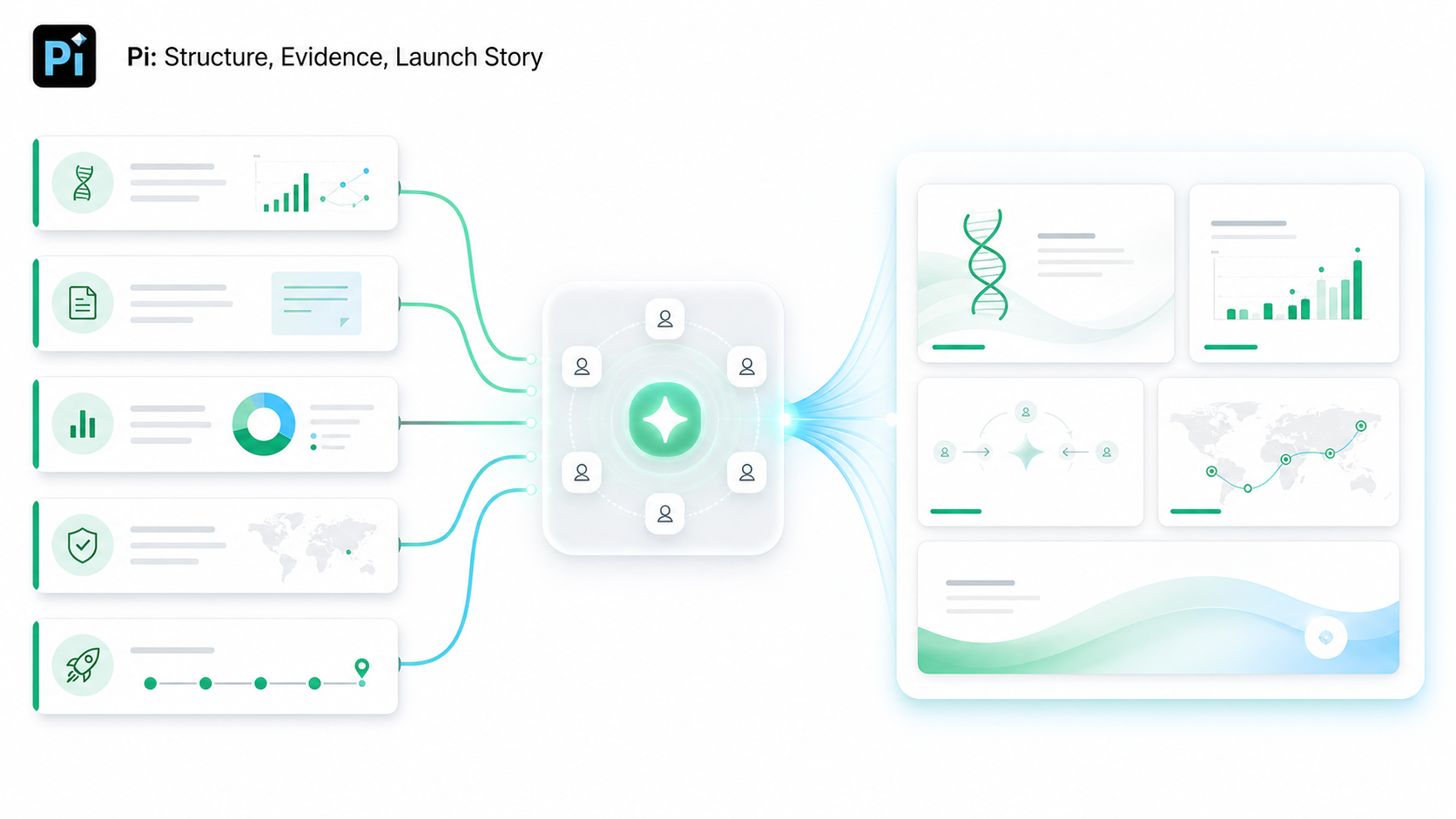
A practical narrative flow starts with the unmet healthcare need. It then explains why existing options fall short, introduces the product, presents supporting evidence, clarifies differentiation, shows launch readiness, and connects the solution to a credible commercial path.
This structure helps the audience understand not only what the product does, but why now, why this team, why this evidence, and why the market should care. Scientific proof creates trust. Commercial structure creates action.
What to Include in a HealthTech Product Launch Pitch Deck
A medical product launch presentation should be concise, but it cannot be vague. Every slide should answer a specific stakeholder question.
Start with the problem. Define the patient, provider, payer, or operational pain point in concrete terms. Avoid broad claims such as “healthcare is broken” unless you can immediately narrow the issue. The audience needs to understand the specific inefficiency, unmet need, diagnostic gap, adherence challenge, or workflow burden.
Next, introduce the target users and use case. For a digital health app, this may include patients, care teams, or health systems. For a device or diagnostic tool, it may include clinicians, labs, hospitals, or specialty practices. Be clear about who uses the product, who benefits from it, and who pays for it.
The product overview should be simple. Show what the product is, how it fits into the healthcare workflow, and what changes for the user. A launch deck is not a technical manual; it is a business and evidence narrative.
Then present scientific evidence. This may include clinical study results, validation data, usability findings, retrospective analysis, operational pilots, or early customer outcomes. The goal is not to show every detail. The goal is to prove that the product’s value proposition is grounded in credible evidence.
A strong deck should also include regulatory or validation status https://www.fda.gov/medical-devices/device-advice-comprehensive-regulatory-assistance/how-study-and-market-your-device where relevant. This section should be carefully worded and fact-based. Do not imply clearance, approval, or clinical performance beyond what has been established.
Finally, connect the product to the market. Include market opportunity, business model, go-to-market plan, launch milestones, team credibility, and the specific ask. The ask may be funding, partnership, pilot access, distribution support, or executive approval.
How to Present Scientific Data Without Losing the Audience
Scientific data visualization is one of the hardest parts of a HealthTech pitch deck. Many teams copy charts directly from papers, technical reports, or internal dashboards. The result may be accurate, but it often fails as presentation communication.
The first rule is to lead with the takeaway. A slide headline should explain what the audience should understand, not simply label the chart. “Pilot showed reduced manual review time” is more useful than “Operational Pilot Results.”
The second rule is to separate primary evidence from supporting detail. The main slide should show the most decision-relevant finding. Additional methods, subgroup analysis, assumptions, or statistical notes can be moved into appendix slides if needed.
The third rule is to reduce chart density. One clear chart with a plain-language insight is usually stronger than four charts competing for attention. Use labels, callouts, and visual hierarchy https://www.nngroup.com/articles/visual-hierarchy-ux-definition/ to guide interpretation. A healthcare audience may be technical, but that does not mean it wants to decode a crowded figure in real time.
Scientific accuracy matters. So does audience cognition. The deck should help people understand the evidence quickly enough to make a business, clinical, or strategic decision.
Balancing Credibility, Compliance, and Commercial Storytelling
HealthTech storytelling requires discipline. A product launch deck should be compelling, but not exaggerated. The safest and strongest approach is to align every business claim with the level of evidence behind it.
If evidence is preliminary, say so. If a pilot was conducted in a limited setting, clarify the context. If results depend on workflow adoption, implementation support, or specific user behavior, make those assumptions visible. Transparent communication builds more trust than inflated certainty.
Commercial storytelling should focus on the pathway from evidence to value. For example, a diagnostic tool may create value through faster triage, improved workflow efficiency, or better resource allocation. A digital health platform may support engagement, monitoring, or care coordination. A medical device may reduce operational friction or expand access to a procedure. Each claim should be framed responsibly and supported by available data.
Where Pi Helps HealthTech Teams Build Stronger Launch Decks
Pi, short for Presentation Intelligence, is an AI presentation maker built for professional business presentations. For HealthTech teams, the challenge is rarely just making slides look attractive. The harder task is organizing scientific evidence, product logic, launch strategy, and stakeholder messaging into one coherent deck.
1. Business Logic Comes Before Slide Styling
Pi helps teams shape complex inputs into a business-ready structure. Instead of starting with decoration, Pi supports the underlying argument: what the audience needs to know, what decision the deck supports, and how each slide advances the narrative.
For a HealthTech pitch deck, that means connecting unmet need, clinical rationale, product differentiation, market opportunity, and launch plan in a sequence that feels clear rather than scattered.
2. Multi-Agent AI Supports Complex Presentation Workflows
HealthTech presentations often involve multiple perspectives: science, product, marketing, commercial, and executive strategy. Pi’s Multi-Agent AI is designed to support deeper presentation workflows where structure, messaging, and visual hierarchy all matter.
This is useful when a team needs to convert clinical data, product notes, market analysis, and go-to-market assumptions into a polished medical product launch presentation without losing the logic between sections.
3. Premium Visual Quality Makes Evidence Easier to Read
A HealthTech deck should feel credible before the presenter speaks. Pi helps create premium, business-grade slides with clear hierarchy, balanced layouts, and professional aesthetics. This matters especially when the deck includes scientific data visualization, product diagrams, market sizing, or launch roadmaps.
The goal is not to make healthcare slides decorative. The goal is to make complex information easier to understand and more appropriate for high-stakes conversations.
HealthTech Pitch Deck Structure: Scientific Rigor vs Commercial Clarity
| Deck Element | Scientific Communication Perspective | Commercial Launch Perspective |
|---|---|---|
| Problem | Defines the clinical or operational gap | Shows urgency and market relevance |
| Evidence | Explains data quality and limitations | Builds trust in product value |
| Product Overview | Clarifies mechanism or workflow fit | Makes the solution easy to understand |
| Differentiation | Compares method, data, or performance | Shows why the product can win |
| Regulatory Status | States validation or approval context | Reduces perceived launch risk |
| Go-to-Market Plan | Considers adoption constraints | Shows path to customers and revenue |
| Ask | Requests study, partner, or expert support | Requests funding, pilots, or commercial action |
A Practical Verdict for HealthTech Launch Teams
A strong HealthTech product launch pitch deck does not choose between science and business. It uses science to earn credibility and commercial storytelling to drive decisions. The audience should leave with a clear understanding of the unmet need, the evidence behind the solution, the readiness of the product, and the path to market.
For teams preparing healthcare startup slides, the biggest risk is not having too much information. It is presenting information without a clear hierarchy. Clinical findings, regulatory context, market opportunity, and launch strategy all matter, but they need to work together.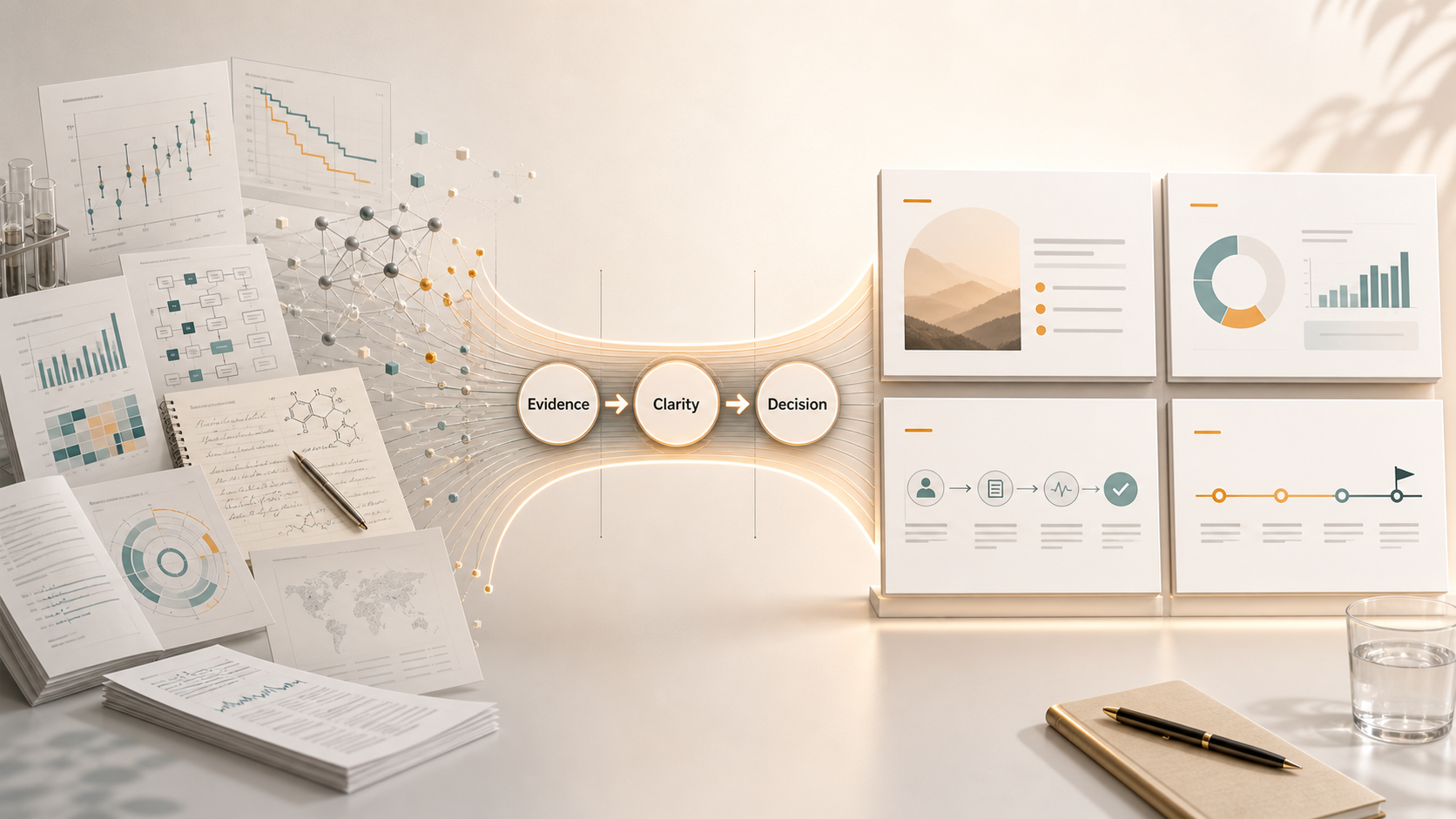
Pi can help HealthTech teams turn complex material into a polished, professional launch presentation that respects scientific nuance while making the business case easier to understand.
Frequently Asked Questions (FAQ)
Q: What should a HealthTech pitch deck include? A: A HealthTech pitch deck should include the problem, target users, clinical or operational pain point, product overview, evidence, data visualization, regulatory or validation status, market opportunity, go-to-market plan, business model, team, and ask.
Q: How should clinical or scientific data be presented in a medical product launch presentation? A: Present the main takeaway first, simplify charts, separate primary evidence from supporting details, and use plain-language headlines. The goal is to make the evidence understandable without overstating what the data proves.
Q: How long should a HealthTech product launch pitch deck be? A: Most launch decks work best at around 10 to 15 core slides, with additional technical, clinical, or regulatory detail placed in an appendix. The exact length depends on the audience and meeting purpose.
Q: Can Pi help create medical product launch presentations? A: Yes. Pi can help structure complex HealthTech material, organize scientific and commercial arguments, improve slide hierarchy, and create a premium business-ready deck. Pi is not a regulatory, diagnostic, or clinical validation tool.


 Cross-Cultural Business Pitches: How to Communicate Globally with Confidence